Author: Jeremiah

  • Piracy? Or Different Rules of the Game

    Author Jeremiah Josey, MECi Group

    This was a good read about so-called “piracy” in China (link here).  What people do not understand is that this is not pirating. This has been labelled such by business lobbyists, out to protect their future revenue streams.

    Being a “Pirate” is taking something from someone else, something that is already owned. A “potential market” no one owns. It’s potential. In the future. Who owns the market is governed by who makes the best product or provides the best service for it – or the market is shared. Entering a market with a copied similar product is simply people doing business. We humans have done this for a very long time. We have always done it. We always will. It’s human.

    We have anti monopoly laws and we have patent protection laws: at their core, the two are in direct conflict with each other. No wonder the West is confused.

    Patents are only a recent invention in human history, and serve to stymie development and innovation, not stimulate it. No, I do not like my products being copied and stolen, but I like how it makes me think: creative and inventive to keep up development and protect – and share – my assets. It makes me create my revenue in different ways, creative ways.

    Google is the good example of being creative. How many patents? And how do they protect new developments? Very few, if any, and very carefully. (Read about it here).

    Patents are dangerous and create false economies. Look at what GM did with electric car and battery technology in the early 2000’s. They “bought” the patents to revolutionary battery technology and then shelved it, along with burying (and destroying) all of their existing physical electric car developments.

    In the end this was good a good thing. The Tesla car company in California rose up from the GM team that was dis-enfranchised, and they now make great cars. The documentary “Who Killed the Electric Car” was created and a following emerged. Now 10 years later and all major marques are releasing electrics cars or hybrid electrics.

    This buy & bury technique has been replicated as long as there has been “product rights”.

    And who invented the radio? There were lots of people involved, and junior school history teaches incorrectly that it was the Italian Marconi?  How, when he copied 17 patents to do so? Patents created by Nicoli Tesla 10 years earlier?

    So, copy, China. Copy, copy, copy. Make things better, more efficient, more sustainable. Please.

    What doesn’t kill us only makes us stronger.

    Jeremiah Josey

  • It’s all in how we learn…

    Author Jeremiah Josey MECi Group

    The best learning is in the field; “on the job”, “through the school of hard knocks”. Getting getting lots and lots of “Nos” is how you work out what is right. The more Nos, the more you learn. This is how nature learns. Go watch it. Watch a vine climbing a fence. It’s kind of funny actually: this is the opposite to how we are taught formally. We are taught to “do it THIS way”, and formally we spend lots and lots of time learning one thing, one skill. If there is one little variation in the reality of our subject, then that learning becomes the WRONG way – it simply will not work. And no skill has been built to see that it IS the wrong way. Even worse, it is wrong to even admit wrong! You have to learn this yourself, the “hard way”, informally. There is only built in you the expectation that it is the right way. What a recipe for disillusionment! Better to start with little knowledge and build a successful path through many, many “Nos”… This is the life.

    Jeremiah Josey

  • Lessons Everywhere – the comparative value of knowledge

    Author Jeremiah Josey, MECi Group

    I changed a tyre today. It wasn’t my tyre. It belonged to an Egyptian vet, well he said he was egyptian and the back of his car was full of needles and drugs for camels so I assumed that was his occupation. He waved me down on the road, 1 hour from the border with Iraq . When I stopped and asked what the problem was the message that got transferred to me in a mix of Arabic and English was that he had a flat tyre and had no jack or tools to change it. No problems. I could help. So I reversed up and proceeded to take my jack and wheel wrench from my car and together we set about to change his tyre. Then I discovered that his wheel nuts where smaller than the wrench I had… problem. I thought to myself: “This is a new car. Why is there no jack and wrench?” So I went around the back and sure enough, in a side panel was the requred tools my friend thought was missing, with of course the correct size wheel lug. In a matter of minutes the tyre was changed and all was good. Driving away I looked at the outside temperature – 42 degrees C – and it occurred to me how valuable a little knowledge was: something that I took for granted could save another man’s life. Assuming that there was no one else on the road, he would have died simple because he didn’t know where to look. And I did. What is that worth? How much does someone know that is given away, without the acknowledgement of that value. It was a valuable lesson.

    Jeremiah Josey

  • Make Up Your Mind

    by Harry Palmer

    The following is a transcript of a talk given by Harry Palmer to the International Avatar Course in June of 2007.

    Look at you all. It feels like the holo-deck of the Starship Enterprise. This is exactly The Avatar Course I would create.

    In Living Deliberately, I briefly outlined the content of four types of belief system: Type One contains mostly dogma, indoctrination, and controlling beliefs. Type Two contains common sense beliefs. Type Three contains scientific, fact-supported beliefs, and Type Four contains intentionally created beliefs, or what you know as primaries. Today I’m going to talk about the intentions that are involved in each of these four types of belief systems.

    First, what does it mean to believe? If you trace the word back to its roots you’ll find that it means to be comfortable with or satisfied with. The belief that a person in a Type One belief system is comfortable with and satisfied with is not always the same thing that a person in a Type Three belief system is comfortable with and satisfied with. We have an idiom in English for that: Different strokes for different folks.

    When I say, “I believe you,” what am I saying? I’m saying that I’m comfortable with what you told me, or that I’m satisfied with what you told me. Truth and efficacy are not necessarily factors of why I believe something. Some truths are very uncomfortable, and hard for me to believe. Some lies are easy for me to believe because they make me feel comfortable. If you tell me that my mistakes are not my fault, it’s easy for me to believe. If you tell me that my mistakes are my responsibility, that is uncomfortable and I would rather not believe you. I find it a little bit of a revelation that belief has more to do with comfort than it has to do with truth. Any effort to find truth will likely take you out of your belief comfort zone.

    If you said to me, “Hey there are three elephants in the parking lot,” and it’s a totally made up story, how am I going to process it?

    Part of my mind goes, “Wow, that’s unusual—three elephants in the parking lot!” Then another part of my mind says, “Well, it could happen.” When we were at the Ocean Center in Daytona Beach, the Ringling Brothers Circus was moving out as we were moving in for the Wizards Course. The Ocean center has a large freight entrance that they call the Elephant door. As the soon as the elephants went out the Elephant Door, our sound truck drove in the Elephant Door. Five minutes sooner and the elephants and the wizards would have run into each other. So I’ve had that experience, and when you say, “Hey there are three elephants in the parking lot,” I check my experiences and decide, “Yea, that could be true. There could be three elephants in the parking lot.”
    In a type one belief system, “Yea. It could be true,” amounts to verification.

    So I believe your story, because it could be true. And I even pass the information on to someone else, “Hey Miken, did you know there are forty elephants in the parking lot.”

    Now, I have been known to tease Miken occasionally, April Fools’ Jokes and that sort of thing. So she’s going to receive my story about the forty elephants in the parking lot with some skepticism. It doesn’t feel comfortable to be fooled. “Sure, Harry,” she says.

    “Would you believe three elephants?”

    “Maybe.” She is checking her experiences to see if it could be true.

    And as long as she’s checking to see if it could be true, I tease her: “And one of the elephants stepped on your car?”

    The intention behind a Type One belief is to be right. A person in a Type One belief system will find this belief very comfortable: “I am right and they are wrong.” This is the intention that leads to war and strife. It sets family against family, and neighbor against neighbor. “I am right and they are wrong.”

    Type One believing is more or less taking an inventory of your memory and determining the plausibility of some statement. As long as you come up with, “Yea, it could be.” And the source of the information is making you right, you will be persuaded. Persuasion in a Type One belief system is based on the emotions connected with being right or being wrong. That is the Type One process of believing: someone says something; it sounds plausible; and you get this little emotional surge because what you suspected was right is really right or what you suspected was wrong is really wrong. This is also the formula for getting elected by a large group: say something, make it sound plausible, and stimulate some righteous emotion. Most political platforms consist of Type One beliefs.

    Ok, lets move up a level to Type Two belief systems and see what it means to believe there.

    With Type One believing, you checked the record to see if a statement was plausible, but with Type Two believing you don’t have to check for memories because you already know. You know without looking. Knowing has more certainty in it than remembering.

    How many times do you have to experience a cause and effect sequence before you know? How many times do you have to repeat an action, always producing the same result, before you can say that you know without looking what the result of that action will be? That is a Type Two belief.

    Type Two beliefs are common sense and there is really no effort involved in believing them. You just know. If someone tells you they dropped an object and it fell to the floor, you’re going to go, “Doh! What did you expect?” You don’t have to check to see if it is plausible, or if the person is making you right, because you know that dropped objects fall to the floor. The belief is transparent. Now, if someone were to say that he dropped an object and it fell up and hit the ceiling, you’re not going to feel that your rightness is threatened, you will just consider that the guy is some sort of whack-job.

    The intention behind Type Two belief systems is to conform and act rationality. And in this case, rationality is based on transparent beliefs that everyone pretty much agrees on. If you want to persuade someone of a type two belief, you appeal to their sense of conformity.

    OK, lets move up another level to the Type Three believing process. If you want to experience a complicated believing process explore a Type Three belief system. The intention behind Type Three belief systems is prove it. You are going to persuade by presenting facts that support your theory, and disputing facts that that don’t support your theory. There is still a shadow of the urge to be right from Type One.

    Type Three is the realm of physical sciences, …and facts, …and hypothesis, …and propositions, …and suppositions, …and theories, …and especially, measuring devices. Did you know that there are measuring device to measure how accurately other measuring devices measure? It’s a fact.
    The mantra of the Type Three believing process is, “What evidence do you have for believing that?” A large part of the Type Three believing process is arguing over evidence. And the only way of settling a Type Three argument is with measuring devices. And even that doesn’t always work.

    The Type Three process of believing is a factual investigation of the perception of a reality, which, based upon transparent beliefs, is assumed to be real.

    For example, two Harvard psychologists discovered that when a 110-volt shock is applied to right side of a rat’s cage, the rat moves immediately to the left side of the cage. From that experiment they were able to conclude that rats are intelligent enough to avoid being shocked. After the experiment, one of the psychologists accidentally stumbled and touched the live electrodes. Responding to his screams the other psychologist, instead of moving away, grabbed the first psychologist and both of them were so severely shocked that they required medical attention.

    Proving that a rat is smarter than two Harvard psychologists. Type Three beliefs are based on scientific evidence, which is based on measuring devices, which measure something that is assumed to be real. Science doesn’t so much extend the frontier of human experience, as it extends backward from the frontier of human experience. Anyway, even with its shortcomings, I’m a big fan of Type Three belief systems because that’s where you find the best power tools and heavy equipment. Why travel across space by changing consciousness when you can ride in a rocket ship? Come on.

    The Type Three believing process is a maturation of the Type One believing process, and the Type Two believing process falls somewhere in between.

    So here you have the evolution of the believing process. You have a linear evolvement of child, adolescent, adult. And you might think, that’s it: superstition evolving into the scientific method. Where else can you go?

    Have you ever noticed when a process is close to reaching perfection that there is often a sideways step that opens a whole new vista? We don’t just evolve linearly, sometimes we mutate sideways. When the electronic vacuum tube had evolved to near perfection, there was a sideways step into the transistor. When propeller driven aircraft had almost reached perfection, there was a sideways step into jet propulsion. When reptilian scales thickened and reached their maximum insulation value, there was a sideways step into feathers. And feathers, which were developed as protection against the cold, took a sideways step into flight.

    Avatar is a sideways step into a Type Four belief system. The intention in a Type Four belief system is to create deliberately. This sideways step is what makes Avatar different from other practices.

    Many people—positive thinkers, inspirational speakers—have speculated that you could create an experience simply by believing in it. In fact, many contend that that is really what people are doing all the time.

    The crux of a Type Four belief system is that the process of believing comes before the process of experiencing. Type One, Two, and Three belief systems look at past experiences to determine present believing. Now we’re talking about a paradigm in which present time believing determines future experience. This really reshuffles the deck.

    The whole concept of believing in something because you are comfortable with it goes out the window. Because you cannot be comfortable with something you haven’t created yet. The definition of belief in a Type Four belief system is closer to “create forward” than it is to “be comfortable with.” The whole believing process has changed.

    Section II of Avatar is a demonstration that belief can create experience. It is quite revolutionary.

    The believing process has taken a sideways step, from passive observation and deduction about what already existed in the past, into an invitation to create what you would like to experience in the future. When you learn to do this, not just talk about it, the skill is priceless. You learn how to create a belief with enough certainty that the experience actually arrives. Wow!This Avatar walks into a bar and says, “Things always work out for me.”

    And the Type Three scientist, taking out his power-measuring device–which also samples and weighs–says, “Do you have any evidence to believe that things always work out for you?”

    The Avatar says, “Nope. Things just always work out for me.”

    And the Type Two rationalist, carrying a whole list of secondaries, says, “Do you have any reason to believe that things are going to work out for you?”
    The Avatar says, “Nope. Things just always work out for me.”

    And both the Type Two and Type Three get very agitated. “That’s crazy,” they say. “Totally delusional, unproven, unsupported, no confirmation, unjustified, you have no evidence or reason to believe that.”

    And the Avatar says, “Not yet.”The Avatar has realized that basing her beliefs on the past is like driving a car by watching where you’ve been.

    With the Type Four believing process, we are talking about awakening source beings, who within a very broad parameter, can make primaries that re-structure their own mind and create future experiences. That is a concept that may take some getting use to: a source being who can
    re-structure his or her own mind. Is your mind controlling you or are you controlling it? If you are entirely new to this concept, the first question you need to answer is, “Whom does my mind belong to?” And the next question is, “Who decides what I believe?”

    Do past events of the physical universe control my mind, or do I control my mind?My mother, bless her heart, could sometimes be an impatient woman. Was your mother ever impatient with you?

    My mom would say, as I hovered in the doorway with snow blowing into the kitchen, “Either go out or stay in.” This of course, presented me with a problem. Should I go out? Or should I stay in? And finally, as I stood there with the door open, snow blowing past, my mother would give her final direction: “Make up your mind. Or I’ll make it up for you.”

    Make up your mind, or I’ll make it up for you. That is pretty much what the universal mother is saying to us all. Make up your mind, or I’ll make it up for you. So who is making up your mind? Is the universe making up your mind? Is the past making up you mind? Or are you living deliberately, and making up your own mind?

    How much avoidable suffering can you save yourself from in the future by re-structuring your own mind today?

    When people really understand the consequences of what you are doing here, they will drop everything to do Avatar.

    Millions of people are trapped in comfortable beliefs that will continue to self-sabotage their lives, their jobs, their relationships, their health; and they are blaming events that they believe they can do nothing about. That is called victim consciousness!

    So discovering that most difficulties are the result of your own comforting beliefs, and that you can do something about them, is a huge step. It is a discovery that requires effort and courage to confront. You can’t become a basketball star by reading about basketball, and you can’t become an Avatar by reading about Avatar; you have to do the training.

    I was going to say, “And boy, is it worth it,” but since you guys now have first hand experience, let me ask you, “Is doing Avatar worth it?”

    (audience applauds and cheers)

    Thank you.

  • The Science of Getting Rich – Wallace D Wattles

    Post by Jeremiah Josey, MECi Group

    There is a thinking stuff from which all things are made, and which, in its original state, permeates, penetrates, and fills the interspaces of the universe.

    Wallace D Wattles

    A thought in this substance produces the thing that is imaged by the thought.

    Man can form things in his thought, and, by impressing his thought upon formless substance, can cause the thing he thinks about to be created.

    In order to do this, man must pass from the competitive to the creative mind; otherwise he cannot be in harmony with the Formless Intelligence, which is always creative and never competitive in spirit.

    Man may come into full harmony with the Formless Substance by entertaining a lively and sincere gratitude for the blessings it bestows upon him. Gratitude unifies the mind of man with the intelligence of Formless Substance, so that man’s thoughts are received by the Formless. Man can remain upon the creative plan only by uniting himself with the Formless Intelligence through a deep and continuous feeling of gratitude.

    Man must form a clear and definite mental image of the things he wishes to have, to do, or to become; and he must hold this mental image in his thoughts, while being deeply grateful to the Supreme that all his desires are granted to him. The man who wishes to get rich must spend his leisure hours in contemplating his Vision, and in earnest thanksgiving that the reality is being given to him. Too much stress cannot be laid on the importance of frequent contemplation of the mental image, coupled with unwavering faith and devout gratitude.

    This is the process by which the impression is given to the Formless, and the creative forces set in motion.

    The creative energy works through the established channels of natural growth, and of the industrial and social order. All that is included in his mental image will surely be brought to the man who follows the instructions given above, and whose faith does not waver. What he wants will come to him through the ways of established trade and commerce.

    In order to receive his own when it shall come to him, man must be active; and this activity can only consist in more than filling his present place. He must keep in mind the Purpose to get rich through the realization of his mental image. And he must do, every day, all that can be done that day, taking care to do each act in a successful manner. He must give to every man a use value in excess of the cash value he receives, so that each transaction makes for more life; and he must so hold the Advancing Thought that the impression of increase will be communicated to all with whom he comes into contact.

    The men and women who practice the forgoing instructions will certainly get rich; and the riches they receive will be in exact proportion to the definiteness of their vision, the fixity of their purpose, the steadiness of their faith, and the depth of their gratitude.

    Wallace D Wattles, “The Science of Getting Rich” 1910

    About Wallace

    The Book at Amazon

    Jeremiah Josey

  • Ricardo Semler on Salaries

    Post by Jeremiah Josey, MECi Group

    We set salaries like this:

    A lot of our people belong to unions, and they negotiate their salaries collectively. Everyone else’s salary involves an element of self-determination.

    Ricardo Semler

    Once or twice a year, we order salary market survey’s and pass them out. We say to people, “Figure out where you stand on this thing. You know what you do, you know what everyone else in the company makes, you know what your friends in other companies make, you know what you need, you know what’s fair.  Come back on Monday and tell us what to pay you.”

    When people ask for too little, we give it to them. By and by, they figure it out and ask for more. When they ask for too much, we give that to them too – at least for the first year. Then, if we don’t feel they’re worth the money, we sit down with them and say, “Look, you make x amount of money, and we don’t think you’re making x amount of contribution. So either we find something else for you to do, or we don’t have a job for you any more. But with half a dozen exceptions, our people have always named salaries we could live with.

    We do a similar thing with titles. Counsellors are counsellors, and partners are partners; these titles are always the same. But with coordinators, it’s not quite so easy. Job titles still mean too much to many people. So we tell coordinators to make up their own titles. They know what signals they need to send inside and outside the company. If they want “Procurement Manager,” that’s fine. And if they want “Grand Panjandrum of Imperial Supplies,” that’s fine too.

    Jeremiah Josey

  • Ricardo Semler on Compensation

    Post by Jeremiah Josey, MECi Group

    Employers began hiring workers by the hour during the Industrial Revolution. Their reasons were simple and rapacious. Say you ran out of cotton thread at 11:30 in the morning. If you paid people by the hour, you could stop the looms, send everyone home, and pay only for the hours actually worked.

    You couldn’t do such a thing today? The law probably wouldn’t let you. The unions certainly wouldn’t let you. Your own self-interest would argue strongly against it. Yet the system lives on. The distinction between wage-earning workers and salaried employees is alive but not well, nearly universal but perfectly silly. The new clerk who lives at home and doesn’t know hot to boil an egg starts on a monthly salary, but the chief lathe operator who’s been with the company 38 years and is a master sergeant in the army reserve still gets paid by the hour.

    At Semco, we eliminated Frederick Winslow Taylor’s segmentation and specialization of work. We ended the wage analyst’s hundred years of solitude. We did away with hourly pay and now give everyone a monthly salary.

    Jeremiah Josey

  • Managing without Managers – Ricardo Semler

    Post by Jeremiah Josey, MECi Group

    Managing without Managers

    by Ricardo Semler, Harvard Business Review (Sep-Oct 1989)

    In Brazil, where paternalism and the family business fiefdom still flourish, I am president of a manufacturing company that treats its 800 employees like responsible adults. Most of them –including factory workers – set their own working hours. All have access to the company books. The vast majority vote on many important corporate decisions. Everyone gets paid by the month, regardless of job description, and more than 150 of our management people set their own salaries and bonuses.

    This may sound like an unconventional way to run a business, but it seems to work. Close to financial disaster in 1980, Semco is now one of Brazil’s fastest growing companies, with a profit margin in 1988 of 10% on sales of $37 million. Our five factories produce a range of sophisticated products, including marine pumps, digital scanners, commercial dishwashers, truck filters, and mixing equipment for everything from bubble gum to rocket fuel. Our customers include Alcoa, Saab, and General Motors. We’ve built a number of cookie factories for Nabisco, Nestle, and United Biscuits. Our multinational competitors include AMF, Worthington Industries, Mitsubishi Heavy Industries, and Carrier.

    Management associations, labor unions, and the press have repeatedly named us the best company in Brazil to work for. In fact, we no longer advertise jobs.  Word of mouth generates up to 300 applications for every available position. The top five managers – we call them counselors – include a former human resources director of Ford Brazil, a 15 year veteran Chrysler executive, and a man who left his job as president of a larger company to come to Semco.

    When I joined the company in 1980, 27 years after my father founded it, Semco had about 100 employees, manufactured hydraulic pumps for ships, generated about $4 million in revenues, and teetered on the brink of catastrophe. All through 1981 and 1982, we ran from bank to bank looking for loans, and we fought persistent, well-founded rumours that the company was in danger of going under. We often stayed through the night reading files and searching the desk drawers of venerable executives for clues about contracts long since privately made and privately forgotten.

    Most managers and outside board members agreed on two immediate needs: to professionalize and to diversify. In fact, both of these measures had been discussed for years but had never progressed beyond wishful thinking.

    For two years, holding on by our fingertips, we sought licenses to manufacture other companies’ products in Brazil. We travelled constantly. I remember one day being in Oslo for breakfast, New York for lunch, Cincinnati for dinner, and San Francisco for the night. The obstacles were great. Our company lacked an international reputation – and so did our country. Brazil’s political eccentricities and draconian business regulations scared many companies away.

    Still, good luck and a relentless program of beating the corporate bushes on four continents finally paid off. By 1982, we had signed seven license agreements. Our marine division –once the entire company – was now down to 60% of total sales. Moreover, the managers and directors were all professionals with no connection to the family.

    With Semco back on its feet, we entered an acquisitions phase that cost millions of dollars in expenditures and millions more in losses over the next two or three years. All this growth was financed by banks at interest rates that were generally 30% above the rate of inflation, which ranged from 40% to 900% annually; There was no long-term money in Brazil at that time, so all those loans had maximum terms of 90 days. We didn’t get one cent in government financing or from incentive agencies either, and we never paid out a dime in graft or bribes.

    How did we do it and survive? Hard work, of course. And good luck – fundamental to all business success. But most important, I think, were the drastic changes we made in our concept of management. Without those changes, not even hard work and good luck could have pulled us through.

    Semco has three fundamental values on which we base some 30 management programs. These values – democracy, profit sharing, and information – work in a complicated circle, each dependent on the other two. If we eliminated one, the others would be meaningless. Our corporate structure, employee freedoms, union relations, factory size limitations – all are products of our commitment to these principles.

    It’s never easy to transplant management programs from one company to another. In South America, it’s axiomatic that our structure and style cannot be duplicated. Semco is either too small, too big, too far away, too young, too old, or too obnoxious.

    We may also be too specialized. We do cellular manufacturing of technologically sophisticated products, and we work at the high end on quality and price. So our critics maybe right. Perhaps nothing we’ve done can be a blueprint for anyone else. Still, in an industrial world whose methods show obvious signs of exhaustion, the merit of sharing experience is to encourage experiment and to plant the seeds of conceptual change. So what the hell.

    Participatory Hot Air

    The first of Semco’s three values is democracy, or employee involvement. Clearly, workers who control their working conditions are going to be happier than workers who don’t. Just as clearly, there is no contest between the company that buys the grudging compliance of its work force and the company that enjoys the enterprising participation of its employees.

    But about 90% of the time, participatory management is just hot air. Not that intentions aren’t good. It’s just that implementing employee involvement is so complex, so difficult, and not uncommonly, so frustrating that it is easier to talk about than to do.

    We found four big obstacles to effective participatory management: size, hierarchy, lack of motivation, and ignorance. In an immense production unit, people feel tiny, nameless, and in capable of exerting influence on the way work is done or on the final profit made. This sense of helplessness is underlined by managers who, jealous of their power and prerogatives, refuse to let subordinates make any decisions for themselves – sometimes even about going to the bathroom. But even if size and hierarchy can be overcome, why should workers care about productivity and company profits? Moreover, even if you can get them to care, how can they tell when they’re doing the right thing?

    As Antony Jay pointed out back in the 1950s in Corporation Man, human beings weren’t designed to work in big groups. Until recently, our ancestors were hunters and gatherers. For more than five million years, they refined their ability to work in groups of no more than about a dozen people. Then along comes the industrial revolution, and suddenly workers are trying to function efficiently in factories that employ hundreds and even thousands. Organizing those hundreds into teams of about ten members each may help some but there is still a limit to how many small teams can work well together. At Semco, we’ve found the most effective production unit to consist of about 150 people. The exact number is open to argument, but it’s clear that several thousand people in one facility makes individual involvement an illusion.

    When we made the decision to keep our units small, we immediately focused on one facility that had more than 300 people. The unit manufactured commercial food-service equipment – slicers, scales, meat grinders, mixers – and used an MRP II system hooked up to an IBM mainframe with dozens of terminals all over the plant. Paperwork often took two days to make its way from one end of the factory to the other. Excess inventories, late delivery, and quality problems were common. We had tried various worker participation programs, quality circles, kanban systems, and motivation schemes, all of which got off to great starts but lost their momentum within months. The whole thing was just too damn big and complex; there were too many managers in too many layers holding too many meetings. So we decided to break up the facility into three separate plants.

    To begin with, we kept all three in the same building but separated everything we could –entrances, receiving docks, inventories, telephones, as well as certain auxiliary functions like personnel, management information systems, and internal controls. We also scrapped the mainframe in favor of three independent, PC-based systems.

    The first effect of the break-up was a rise in costs due to duplication of effort and a loss in economies of scale. UnfortunateIy, balance sheets chalk up items like these as liabilities, all with dollar figures attached, and there’s nothing at first to list on the asset side but airy stuff like “heightened involvement” and “a sense of belonging.” Yet the longer term results exceed our expectations.

    Within a year, sales doubled, inventories fell from 136 days to 46, we unveiled eight new products that had been stalled in R&D for two years, and overall quality improved to the point that a one-third rejection rate on federally inspected scales dropped to less than 1%. Increased productivity let us reduce the workforce by 32% through attrition and retirement incentives.

    I don’t claim that size reduction alone accomplished all this, just that size reduction is essential for putting employees in touch with one another so they can co-ordinate their work. The kind of distance we want to eliminate comes from having too many people in one place, but it also comes from having a pyramidal hierarchy.

    Pyramids and Circles

    The organizational pyramid is the cause of much corporate evil, because the tip is too far from the base. Pyramids emphasize power, promote insecurity; distort communications, hobble interaction, and make it very difficult for the people who plan and the people who execute to move in the same direction. So Semco designed an organizational circle. Its greatest advantage is to reduce management levels to three – one corporate level and two operating levels at the manufacturing units.

    It consists of three concentric circles. One tiny, central circle contains the five people who integrate the company’s movements. These are the counselors I mentioned before. I’m one of them, and except for a couple of legal documents that call me president, counselor is the only title I use. A second, larger circle contains the heads of the eight divisions – we call them partners. Finally, a third, huge circle holds all the other employees. Most of them are the people we call associates; they do the research, design, sales, and manufacturing work and have no one reporting to them on a regular basis. But some of them are the permanent and temporary team and task leaders we call co-ordinators. Counselors, partners, co-ordinators, and associates. Four titles. Three management layers.

    The linchpins of the system are the co-ordinators, a group that includes everyone formerly called foreman, supervisor, manager, head, or chief. The only people who report to co-ordinators are associates. No co-ordinator reports to another co-ordinator – that feature of the system is what ensures the reduction in management layers.

    Like anyone else, we value leadership, but it’s not .the only thing we value. In marine pumps for example, we have an applications engineer who can look at the layout of a ship and then focus on one particular pump and say, “That pump will fail if you take this thing north of the Arctic Circle.” He makes a lot more money than the person who manages his unit. We can change the manager, but this guy knows what kind of pump will work in the Arctic, and that’s worth more. Associates often make higher salaries than co-ordinators and partners, and they can increase their status and compensation without entering the “management” line.

    Managers and the status and money they enjoy – in a word, hierarchy – are the single biggest obstacle to participatory management. We had to get the managers out of the way of democratic decision making, and our circular system does that pretty well.

    But we go further. We don’t hire or promote people until they’ve been interviewed and accepted by all their future subordinates. Twice a year, subordinates evaluate managers. Also twice a year, everyone in the company anonymously fills out a questionnaire about company credibility and top management competence. Among other things, we ask our employees what it would take to make them quit or go on strike.

    We insist on making important decision’s collegially, and certain decisions are made by a company-wide vote. Several years ago, for example, we needed a bigger plant for our marine division, which makes pumps, compressors, and ship propellers. Real estate agents looked for months and found nothing, So we asked the employees themselves to help, and over the first weekend they found three factories for sale, all of them nearby. We closed up shop for a day, piled everyone into buses, and drove out to inspect the three buildings. Then the workers voted – and they chose a plant the counselors didn’t really want. It was an interesting situation – one that tested our commitment to participatory management.

    The building stands across the street from a Caterpillar plant that’s one of the most frequently struck factories in Brazil. With two tough unions of our own, we weren’t looking forward to front-row seats for every labor dispute that crime along. But we accepted the employee decision, because we believe that in the long run, letting people participate in the decisions that affect their lives will have a positive effect on employee motivation and morale.

    We bough the building and moved in. The workers designed the layout for a flexible manufacturing system, and they hired one of Brazil’s foremost artists to paint the whole thing, inside and out, including the machinery. That plant really belongs to its employees. I feel like a guest every time I walk in.

    I don’t mind, The division’s productivity, in dollars per year per employee, has jumped from $14,200 in 1984 – the year we moved – to $37,500 in 1988 and for 1989 the goal is $50,000. Over the same period, market share went from 54% to 62%.

    Employees also outvoted me on the acquisition of a company that I’m still sure we should have bought. But they felt we weren’t ready to digest it, and I lost the vote. In a case like that, the credibility of our management system is at stake. Employee involvement must be real, even when it makes management uneasy. Anyway, what is the future of an acquisition if the people who have to operate it don’t believe it’s workable?

    Hiring Adults

    We have other ways of combating hierarchy too. Most of our programs are based on the notion of giving employees control over their own lives. In a word, we hire adults, and then we treat them like adults.

    Think about that. Outside the factory, workers are men and women who elect governments, serve in the army, lead community projects, raise and educate families, and make decisions every day about the future. Friends solicit their advice. Salespeople court them. Children and grandchildren look up to them for their wisdom and experience. But the moment they walk into the factory, the company transforms them into adolescents. They have to wear badges and name tags, arrive at a certain time, stand in line to punch the clock or eat their lunch, get permission to go to the bathroom, give lengthy explanations every time they’re five minutes late, and follow instructions without asking a lot of questions.

    One of my first moves when I took control of Semco was to abolish norms, manuals, rules, and regulations. Everyone knows you can’t run a large organization without regulations, but everyone also knows that most regulations are poppycock. They rarely solve problems. On the contrary; there is usually some obscure comer of the rule book that justifies the worst silliness people can think up. Common sense is a riskier tactic because it requires personal responsibility.

    It’s also true that common sense requires just a touch of civil disobedience every time someone calls attention to something that’s not working. We had to free the Thoreaus and the Tom Paines in the factory and come to terms with that fact that civil disobedience was not an early sign of revolution but a clear indication of common sense at work.

    So we replaced all the nitpicking regulations with the rule of common sense and put our employees in the demanding position of using their own judgement.

    We have no dress code, for example. The idea that personal appearance is important in a job – any job – is baloney. We’ve all heard that salespeople, receptionists, and service reps are the company’s calling cards, but in fact how utterly silly is that. A company that needs business suits to prove its seriousness probably lacks more meaningful proof. And what customer has ever canceled an order because the receptionist was wearing jeans instead of a dress? Women and men look best when they feel good. IBM is not a great company because its salespeople dress to the special standard that Thomas Watson set. It’s a great company that also happens to have this quirk.

    We also scrapped the complex company rules about travel expenses – what sorts of accommodations people were entitled to, whether we’d pay for a theater ticket, whether a free call home meant five minutes or ten. We used to spend a lot of time discussing stuff like that. Now we base everything on common sense. Some people stay in four-star hotels and some live like spartans. Some people spend $200 a day while others get by on $125. Or so I suppose. No one checks expenses, so there is no way of knowing. The point is, we don’t care. If we can’t trust people with our money and their judgement, we sure as hell shouldn’t be sending them overseas to do business in our name.

    We have done away with security searches, storeroom padlocks, and audits of the petty cash accounts of veteran employees. Not that we wouldn’t prosecute a genuinely criminal violation of our trust. We just refuse to humiliate 97% of the work force to get our hands on the occasional thief or two-bit embezzler.

    We encourage – we practically insist on – job rotation every two to five years to prevent boredom. We try hard to provide job security, and for people over 50 or who’ve been with the company for more than three years, dismissal procedures are extra complicated.

    On the more experimental side, we have a program for entry-level management trainees called “Lost in Space” whereby we hire a couple of people every year who have no job description at all. A “godfather” looks after them and for one year they can do anything they like as long as they try at least 12 different areas or units.

    By the same logic that governs our other employee programs, we have also eliminated time clocks. People come and go according to their own schedules – even on the factory floor. I admit this idea is hard to swallow, most manufacturers are not ready for factory-floor flextime. But our reasoning was simple.

    First, we use cellular manufacturing systems. At our food-processing equipment plant, for example, one cell makes only slicers, another makes scales, another makes mixers, and so forth. Each cell is self-contained, so products – and their problems – are segregated from each other.

    Second, we assumed that all our employees were trustworthy adults. We couldn’t believe they would come to work day after day and sit on their hands because no one else was there. Pretty soon, we figured, they would start co-ordinating their work hours with their co-workers.

    And that’s exactly what happened, only more so. For example, one man wanted to start at 7am, but because the forklift operator didn’t come until 8, he couldn’t get his parts. So a general discussion arose, and the upshot was that now everyone knows how to operate a forklift. In fact, most people can now do several jobs. The union has never objected because the initiative came from the workers themselves. It was their idea.

    Moreover, the people on the factory floor set the schedule, and if they say that this month they will build 48 commercial dishwashers, then we can go play tennis, because 48 is what they’ll build.

    In one case, one group decided to make 220 meat slicers. By the end of the month, it had finished the slicers as scheduled – except that even after repeated phone calls, the supplier still hadn’t produced the motors. So two employees drove over and talked to the supplier and managed to get delivery at the end of that day, the 31st. Then they stayed all night, the whole work force, and finished the lot at 4:45 the next morning.

    When we introduced flexible hours, we decided to hold regular follow-up meetings to track problems and decide how to deal with abuses and production interruptions. That was years ago, and we haven’t yet held the first meeting.

    Hunting the Woolly Mammoth

    What makes our people behave this way? As Antony Jay points out, corporate man is a very recent animal. At Semco, we try to respect the hunter that dominated the first 99.9% of the history of our species. If you had to kill a mammoth or do without supper, there was no time to draw up an organization chart, assign tasks, or delegate authority. Basically, the person who saw the mammoth from farthest away was the Official Sighter, the one who ran fastest was the Head Runner, whoever threw the most accurate spear was the Grand Marksman, and the person all others respected most and listened to was the Chief. That’s all there was to it. Distributing little charts to produce an appearance of order would have been a waste of time. It still is.

    What I’m saying is, put ten people together, don’t appoint a leader, and you can be sure that one will emerge. So will a sighter, a runner, and whatever else the group needs. We form the groups, but they find their own leaders. That’s not a lack of structure that’s just a lack of structure imposed from above.

    But getting back to that mammoth, why was it that all the members of the group were so eager to do their share of the work – sighting, running, spearing, chiefing – and to stand aside when someone else could do it better? Because they all got to eat the thing once it was killed and cooked. What mattered was results, not status.

    Corporate profit is today’s mammoth meat. And though there is a widespread view that profit sharing is some kind of socialist infection, it seems to me that few motivational tools are more capitalist. Everyone agrees that profits should belong to those who risk their capital, that entrepreneurial behavior deserves reward, that the creation of wealth should enrich the creator. Well, depending on how you define capital and risk, all these truisms can apply as much to workers as to shareholders.

    Still, many profit-sharing programs are failures, and we think we know why. Profit sharing won’t motivate employees if they see it as just another management gimmick, if the company makes it difficult for them to see how their own work is related to profits and to understand how those profits are divided.

    In Semco’s case, each division has a separate profit-sharing program. Twice a year, we calculate 23% of after-tax profit on each division income statement and give a check to three employees who’ve been elected by the workers in their division. These three invest the money until the unit can meet and decide – by simple majority vote – what they want to do with it. In most units, that’s turned out to be an equal distribution. If a unit has 150 workers, the total is divided by 150 and handed out. It’s that simple. The guy who sweeps the floor gets just as much as the division partner.

    One division chose to use the money as a fund to lend out for housing construction. It was a pretty close vote, and the workers may change their minds next year. In the meantime, some of them have already received loans and have begun to build themselves houses. In any case, the employees do what they want with the money. The counselors stay out of it.

    Semco’s experience has convinced me that profit-sharing has an excellent chance of working when it crowns a broad program of employee participation. When the profit-sharing criteria are so clear and simple that the least gifted employee can understand them, and perhaps most important, when employees have monthly access to the company’s vital statistics – costs, overhead, sales, payroll, taxes, profits.

    Transparency

    Lots of things contribute to a successful profit-sharing program: low employee tumover, competitive pay, absence of paternalism, refusal to give consolation prizes when profits are down, frequent (quarterly or semi-annual) profit distribution, and plenty of opportunity for employees to question the management decisions that affect future profits. But nothing matters more than those vital statistics – short, frank, frequent reports on how the company is doing. Complete transparency. No hocus-pocus, no hanky-panky, no simplifications.

    On the contrary, all Semco employees attend classes to learn how to read and understand the numbers, and it’s one of their unions that teach the course. Every month, each employee gets a  balance sheet, a profit-and-loss analysis, and a cash-flow statement for his or her division. The reports contain about 70 line items (more, incidentally than we use to run the company, but we don’t want anyone to think we’re withholding information).

    Many of our executives were alarmed by the decision to share monthly financial results with all employees. They were afraid workers would want to know everything like how much we pay executives. When we held the first large meeting to discuss these financial reports with the factory committees and the leaders of the metalworkers’ union, the first question we got was, “How much do division managers make?” We told them. They gasped. Ever since, the factory workers have called them “maharaja.”

    But so what? If executives are embarrassed by their salaries, that probably means they aren’t earning them. Confidential payrolls are for those who cannot look themselves in the mirror and say with conviction, “I live in a capitalist system that remunerates on a geometric scale. I spent years in school, I have years of experience, I am capable and dedicated and intelligent. I deserve what I get.”

    I believe that the courage to show the real numbers will always have positive consequences over the long term. On the other hand, we can show only the numbers we bother to put together, and there aren’t as many as there used to be. In my view, only the big numbers matter. But Semco’s accounting people keep telling me that since the only way to get big numbers is to add up the small ones, producing a budget or report that includes every tiny detail would require no extra effort. This is an expensive fallacy, and a difficult one to eradicate.

    A few years ago, the U.S. president of Allis-Chalmers paid Semco a visit. At the end of his factory tour, he leafed through our monthly reports and budgets. At the time, we had our numbers ready on the fifth working day of every month in super-organized folders, and were those numbers comprehensive! On page 67, chart 112.6, for example, you could see how much coffee the workers in Light Manufacturing III had consumed the month before. The man said he was surprised to find such efficiency in a Brazilian company. In fact, he was so impressed that he asked his Brazilian subsidiary, an organization many times our size, to install a similar system there.

    For months, we strolled around like peacocks, telling anyone who cared to listen that our budget system was state-of-the-art and that the president of a Big American Company had ordered his people to copy it. But soon we began to realize two things. First, our expenses were always too high, and they never came down because the accounting department was full of overpaid clerks who did nothing but compile them. Second, there were so damn many numbers insidethe folder that almost none of our managers read them. In fact, we knew less about the company then, with all that information, than we do now without it.

    Today we have a simple accounting system providing limited but relevant information that we can grasp and act on quickly. We pared 400 cost centers down to 50. We beheaded hundreds of classifications and dozens of accounting lines. Finally, we can see the company through the haze.

    As for Allis-Chalmers, I don’t know whether it ever adopted our old system in all its terrible completeness, but l hope not. A few years later, it began to suffer severe financial difficulties and eventually lost so much market share and money that it was broken up and sold. I’d hate to think it was our fault.

    In preparing budgets, we believe that the flexibility to change the budget continually is much more important than the detailed consistency of the initial numbers. We also believe in the importance of comparing expectations with results. Naturally, we compare monthly reports with the budget. But we go one step further. At month’s end, the co-ordinators in each area make guesses about unit receipts, profit margins, and expenses. When the official numbers come out a few days later, top managers compare them with the guesses to judge how well the co-ordinators understand their areas.

    What matters in budgets as well as in reports is that the numbers be few and important and that people treat them with something approaching passion. The three monthly reports, with their 70 line items, tell us how to run the company; tell our managers how well they know their units, and tell our employees if there’s going to be a profit. Everyone works on the basis of the same information, and everyone looks forward to its appearance with what I’d call fervent curiosity.

    And that’s all there is to it. Participation gives people control of their work, profit sharing gives them a reason to do it better, information tells them what’s working and what isn’t.

    Letting Them Do Whatever the HeIl They Want

    So we don’t have systems or staff functions or analysts or anything like that. What we have are people who either sell or make, and there’s nothing in between. Is there a marketing department? Not on your life. Marketing is everybody’s problem. Everybody knows the price of the product. Everybody knows the cost. Everybody has the monthly balance sheet that says exactly what each of them makes, how much bronze is costing us, how much overtime we paid, all of it. And the employees know that 23% of the after-tax profit is theirs.

    We are very, very rigorous about the numbers. We want them in on the fourth day of the month so we can get them back out on the fifth. And because we’re so strict with the financial controls, we can be extremely lax about everything else. Employees can paint the walls any color they like. They can come to work whenever they decide. They can wear whatever clothing makes them comfortable. They can do whatever the hell they want. It’s up to them to see the connection between productivity and profit and to act on it.

    Jeremiah Josey

  • Read The Manual

    Read The Manual

    Author Jeremiah Josey, MECi Group

    A handful of years ago I was asked to join Western Mining and build a major part of their new AUD 1 billion fertiliser facility in far north western Queensland. Western Mining was then led by two icons of the Australian mining industry, Hugh Morgan and Andrew Michelmore. The facility was going to built at a remote site called Phosphate Hill. I grew up in areas like Phosphate Hill so I was excited to be outback again.

    I arrived on the project when design and build tenders were being evaluated in WMC offices at Riverside Centre, 123 Eagle Street, Brisbane, Australia. Coming from the “grubby” oil and gas game, you gotta love the Australian mining business: red carpet and art work in the in the foyer and lobby areas and almost-gold faucets in the toilets. I was the client engineer in charge of the Phosphoric Acid facility and my project engineer was going to be from Bechtel. Together we would be taking phosphate rich rock and dissolving it in sulphuric acid to make feed stock for fertiliser. Fun stuff. I was 26 years old

    The Phosphate Hill Fertiliser Facility, North West Queensland

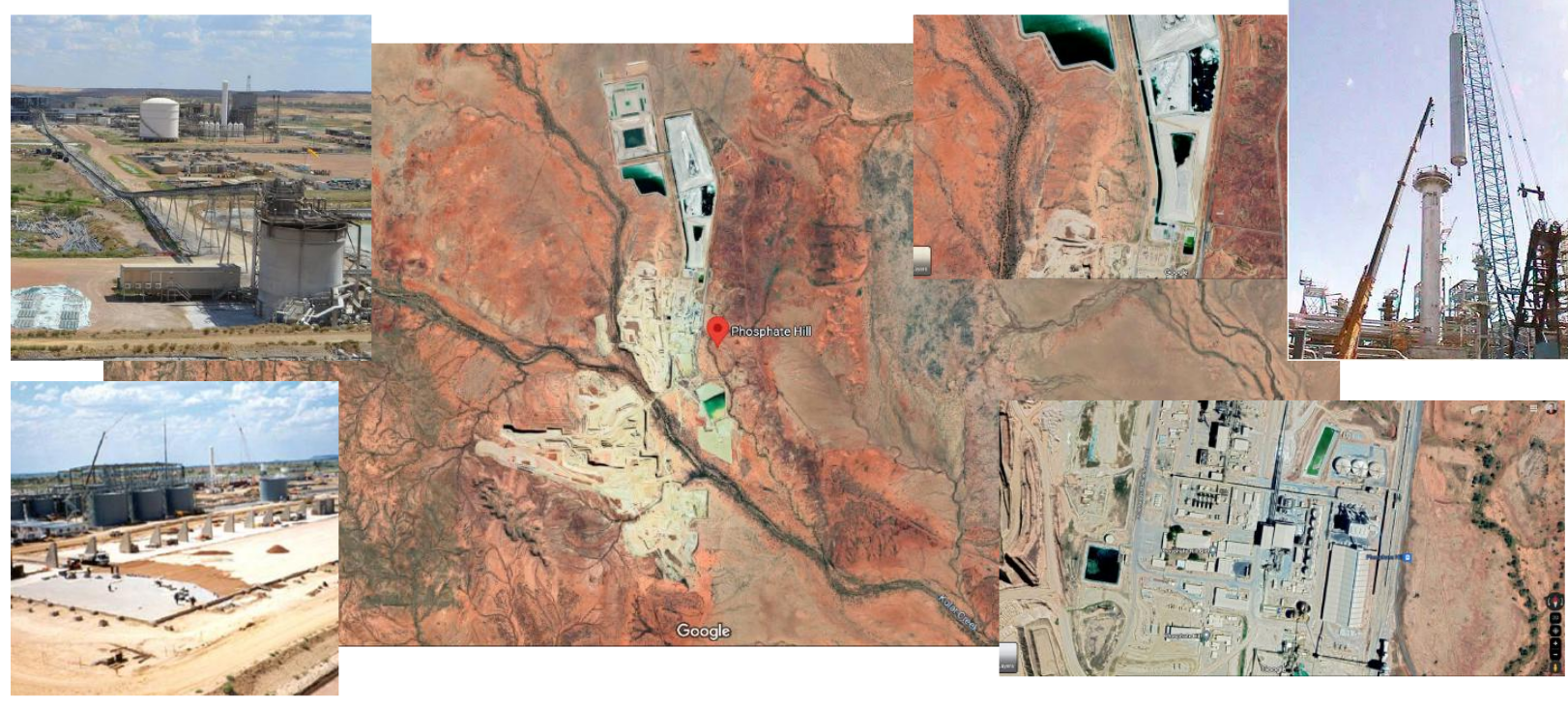
    The facility manufactures 1,000,000 tonnes per year of ammonium phosphate fertilisers and is located approximately 1,000 km west of Townsville on a large phosphate rock deposit. The entire operation combines world-class, low-cost manufacturing facilities spread across multiple sites. At Phosphate Hill, ammonia is produced from methane gas sourced Santos’s Ballera gas facility located 800 km to the South. Sulphuric acid is supplied via specialised GATX rail cars delivered by train from a purpose built sulphuric acid plant located 150 km to the north at Mount Isa. There, waste gases containing sulphur are collected from Xstrata’s copper smelting facilities and converted into acid. To the east in Townsville there are the warehousing and export port facilities. During construction approximately 1,000 personnel where located on site, housed at a camp at the nearby Monument. Now a crew of about 250 personnel cover the operations of:
    – Mining and Gypsum stacking
    – Beneficiation
    – Ammonia production
    – Phosphoric acid production
    – Granulation

    Built by WMC Resources, owned briefly by BHP, now owned by Incitec Pivot
    Phosphate Hill Fertiliser Facilities

    Bechtel where wrapping up their assessment of tenders so there wasn’t much to do except watch what was happening. And then visit all the locations. The chosen contractor was a consortium of Norsk Hydro‘s using hemihydrate technology (based in Rotterdam, Netherlands), Mitsui process design (Tokyo, Japan) and Clough detailed design and construction (Perth, Australia). Norsk had operating plants in Thailand and Jordan, so within a few weeks of arriving in WMC’s offices on Eagle Street, three of us from WMC and the Bechtel project engineer went on a world tour taking in Japan, Thailand, Jordan and The Netherlands. It was 1997. The trip is a story in itself, but most memorable was the introduction to Japan which I savoured and repeated several times since including an extended period I call my “Japan time”. There’s a reason why Toyota is the best car in the world.

    For fun, I formed the social club during the construction period and the club became responsible for beer purchases. We did ‘beer and barbies’ – this was Australia after all. We averaged 2 cases, or 48 375 ml cans of full strength beer per person per week. That was a “six pack” every night for every person in our 1,000 construction crew for 3 years. That was a lot of beer for a construction site with zero alcohol policy. I’m surprised that only 1 person was killed during the work.

    As an aside, Bechtel have an amazing story. Still a family owned business, it was founded around 1898 and their key to success is taking a 5% commission on all procurement they manage. And they want to manage all of it. [Pro tip: always be between those that can, and those than can’t. Be he middle man!].

    I owe a lot of my lessons to the head of my construction consortium, Michael ‘Mike’ Anderson. A veteran in project management, he knew how to build a plant and he knew how to make it profitable. I just had to watch and learn. He used the most wicked, and most effected application of critical chain theory I had ever seen. His got his team to make estimates for their respective work scopes: BOQs, GAs, structural, concrete, tendering etc. Then he got his project planner to make two plans: one with the information as given. And a second plan with all of the times simply cut in half. He then put the first plan into a locked drawer and got his planner to swear he would never tell anyone about the first plan. The project then proceeded to run on the second “compressed” schedule. It was what I call planning to win as opposed to planning to fail as traditional Gantt chart planning does. It worked perfectly, with Mike coming in 6 months early on his contract. My task as the client then evolved into making the path as smooth as possible for Mike and his team to do what they had to do: build a world class phosphoric acid plant.

    Mike the man

    DELKOR Filter Belt similar to the four at Phosphate Hill

    One of the things that struct me was the laissez-faire, relaxed nature of the WMC/Bechtel management office. I had come from the oil industry. Among my previous gigs after the refinery, were as project engineer for Chevron’s USD 4.5 billion gas pipeline from their Kutubu gas fields in Papua New Guinea to Gladstone; and saving the Moonie to Brisbane oil pipeline which was in danger of being washed out across it’s multiple creek crossings and Santos was stalled on the fix for more than 2 years on what to do. (More stories there also). Why so relaxed for such a huge facility? It wasn’t until I walked into my first phosphoric acid facility in Thailand to understand why. There where no consequence of failure. If anything went wrong, it would just be a plop on the ground, not an explosion in the air. It was very hard to get killed in a phosphoric acid plant. Once I realised this, all stress about the project fell away from me. Nothing could go wrong. Well almost. We “forgot” the fluorine. More on that next.

    Once the process design and preliminary layouts where done we where ready for HAZOPing. Coming from the oil and gas industry I was an expert, having re-designed the entire HAZOP procedure at BP where I was running 1 or 2 HAZOPs each month. Each were small – only a few hours sometimes, but every HAZOP runs the same. For Phosphate Hill we planned to HAZOP Japan for about 2 weeks to go through the 100 or so P&IDs we had. On the very first day we spent the entire day being ‘taught’ how to HAZOP by an ex-Shell consultant. We spent the entire day HAZOPing a 3 meter deep sump that ”could’ occasionally get hot water into it… It was hair pulling stuff. It was so draining that we actually forgot to properly evaluate the floruie coming from the rock. Passed off as “insignficant”, the singficant amounts of flourine in the rock caused massive problems later on during operations with staff having to wear alsmot full hazmat suits to go anywhere near the filter belts. When looking back, one of our process engineers had only ever worked on low floruine rock. If I wasnt’ so bored at the HAZOP I might have raise the issue to consider how much gas would be released compared to other sites worldwide. We would be one of the largest.

    P&ID for HAZOP

    The most immediate task I set for myself after the world tour and I was back in the office in Brisbane was to create a battery limit interface for my plant. There were hundreds of interactions coming from multiple contractors into (and out of) the phosphoric acid and I was the only one who really cared that they all worked. Even my contractor, Mike, ever playing the contractor game, would come up with inputs and outputs that simply didn’t align with other contracts. Granted however he was totally organised and no one else was. He was first so others had to catch up to him. So I became the negotiator in-between them all. After all, I wanted my plant to work. And talking with everyone else in the project I got to learn about how everything worked.

    One of the most revealing events in this process was when I went to the project’s chief scientist with two pieces of paper: one was what the specification of what the Benefication plant was going to produce (ground up wet rock) and what the phosphoric acid was expected to receive (also ground up wet rock). They where different. At first I thought it would be a simple matter of alignment. A casual hallway chat. When nothing happened, I escalated to email. And then further discussions. This continued for some weeks until I was told to “just let it go. Ignore it”. When one of the senior managers on the project arrived to the office in a new Porsche a few weeks later, I was started to get the idea.

    But I was enjoying the complexity of the project. From a office overlooking the Story Bridge and the Brisbane River in one of the world’s most prestigious buildings, after a few months I moved to the site at Phosphate Hill and was baking in a construction donger before the air condition had been installed. For next several years I watched another creation of humanity come together and rising out of the earth.

    Over the duration of the project I kept negotiating my salary higher and higher until I was told that I was the highest paid member of the staff at my level. A few years later when I was consulting at Mt Isa mines and at the deepest point in their 3,5000 deep copper mine, I became friends with another engineer who told me he had been offered a job at WMC to run the phosphate acid project on such-and-such a date. Remembering back, that was my position! And it aligned with one of my negotiation pay raise cycles. I had obviously negotiated too well and my new friend was offered my place, but at even less than what I had started at WMC. He – obviously – didn’t accept. Again it told me about the games going on behind the scenes on the project.

    I had drawn up a Gantt chart on my office white board which remained to the end of the project. It showed how the how the entire project would be delayed by anywhere from 12 to 18 months and how my phosphoric acid plant would be 6 months early. It was always an interesting talking piece with the other team members.

    When drawing up my battery limit management plan, it was also apparent that the Phosphogypsum waste coming from my plant wasn’t being addressed. When I raised the question, again I was told not to worry about it. That is until later. The gypsum stacking facility had been entirely forgotten from the project.

    Eventually I was asked to also take care of the Gypsum stacking facilities – not a small thing as you can see from the google map. When the answer was “no” to my question, “would I be paid more?”, I declined. However I picked it up some time later because I was getting bored waiting for the rest of the project to catch up which was by now clear to everyone else running late. So I had a bunch of time up my sleeve. I also met an awesome chap who fixed dirt like I’ve never seen it fixed before. He was a civil construction guy brought in to build the earthen dams to hold millions of tonnes of future accumulation of phosphogypsum forever. Yes, there’s no apparent commercial use for these huge piles of white stuff.

    Through my time building the gypsum handling facilities I met and worked with one of the former advisers to the Queensland Premier, Sir Joh Bjelke-Petersen. This person, Mr Smith will do, was the architect of the entire North West Region Minerals province and the reason why the Phosphate Hill actually went ahead at all. Mr. Smith had an ambitious plan. He brought together arguing, warring government and semi-government factions of the likes of Santos, Queensland Rail, Mount Isa Mines and a bevy of private companies. Over 2 years he negotiated and cajoled to bring everyone into alignment: to install gas pipelines, have lower rail transport prices, make available port land in Townsville, and share port facilities with the coal industry amongst many other key factors. Twenty contracts where signed in 2 weeks at the end of those 2 years and the Phosphate Hill Fertiliser Facilities became possible. It was incredible to hear his story as he regaled them to me in the best business clubs across Brisbane.

    Sir Joh Bjelke-Petersen

    One day Mr Smith casually slid two massive tomes across the table to me. Each was 3 inches thick, cheaply bound in green cardboard and red spiral spine wire. I asked what they were and he replied they where the project manual for Phosphate Hill, in two volumes. Wow! I never knew these even existed. For days after I plunged into them and their 1980’s typewritten paper. I was amazed that the entire project existed in such detail from the mid 1980’s. In fact every single problem that had delayed the rest of the project had been identified, thought about and a solution or solutions already determined and documented. If everyone on the project had read this report before the project started hundreds of millions of dollars would have been saved in mistakes, cost overruns and simple ignorance. But then, I realised that wasn’t the main agenda. In the midst of mistakes money can be made.

    As Phosphate Hill was being commissioned someone else handed me the book Cash Flow Quadrant, by Robert Kiyosaki, and I didn’t look back.

    In a few days I read the book, consuming it with zeal. Suddenly I had all of the vocabulary I didn’t have before. All the knowledge that had been bouncing around in my mind came into alignment. I was financially literate. Well 101 level anyway. Within 6 months I was out of WMC, the project was into operations mode now, and within a further 3 months, after looking at more than 1,000 prospect rental properties across Australia, started on my property acquisition spree. I remembered Kiyoski’s advice “you only make money when you buy”. That leads to another story of how I turned AUD 25,000 into more than AUD 1,000,000 in less than 18 months. I’ve only ever consulted for fun thereafter.

    So, reading is the path to success. That was a clear lesson from my time with WMC.

    Jeremiah Josey

  • Flying Solo or Craftsman, or Businessman??

    Post by Jeremiah Josey, MECi Group

    This is a great discussion between Robert Gerrish or FlyingSolo and Michael Gerber, of E-Myth fame.

    Michael Gerber Interview by Robert Gerrish

    I made some comments to the interview:

    Business is a system. People working in the system have a “job”. Many solo runners in “business” operate in a “craft”, which is neither job nor system, but somewhere in between. Rather like a hobby they enjoy doing, but this hobby impacts little more than themselves and their family. If the soloist is doing the same thing over and over, then they have a job not a business, nor a craft for that matter. I doubt if they will like it.

    The best business operates as a tribe – a large group of people (up to 150) working in a harmonious, contiguous unit. After all, we are humans, animals, and working together is what we enjoy the most.

    Gerber is 100% correct – his wider world experience gives him that view point. His purpose is to touch as many people as possible, and help others to achieve the same, not just 1 or 2 (or the nuclear family) as Robert Gerrish promotes.

    Gerrish has a kind of “screw the corporation, we can do it on our own” approach. Which, coincidently – based on tribal research – is about 48% of the population (stage 3 – See the TED talk [David Logan on tribal leadership] for what stage 3 is).
    (David Logan on Tribal Leadership).

    This is probably why Gerrish feels right in what he believes: because he can find a lot of people to agree with him. Gerber is talking about the top 2% (stage 1) of the population who are already there, as well as the next 22% (stage 4) who know they can do it better.

    So in summary, it’s horses for courses, each to their own, et alii.  It’s being clear with your true feelings inside yourself, and why-you-are-really-doing-that-which-you-are-doing.  Are you truly enjoying it?  Yes?  Then keep going, keep doing it.  No? Then stop as soon as you can and find what makes your heart sing.  A bunch of happy folk is a heck lot more enjoyable to be around than sad, hard-done-by folk. Besides, life for youself is a whole lot betterer!

    See my other blogs about the same topic:

    Jeremiah Josey

  • Burqa Woman

    Author Jeremiah Josey, MECi Group

    I’m sitting at Arrivals with my regulation Starbucks semi- daily black brew. No sugar.  Grande.  I’m waiting.  All nationalities are arriving.  It’s busy.  I’m observing. Looking. Staring.

    A couple emerge.  Business or married I can’t tell.  Either way it’s not nice.  Man and woman.  Perhaps Swiss or German from their looks.  Something like that.  He’s 6’1″, dark blue suit, flat shoes, black soft leather brief case.  Right hand.  He’s walking fast, but comfortable.  He’s fit. Head is up.  Looking where he’s going.  He’s been here before.

    Behind him, she’s 5’7″, 4″ heels.  Fit too, but not set up.  Blond pony tail, the almost-stiletto heels, tight grey skirt and matching business jacket, small hand bag.  Scurrying.  She’s clutching a wad of files in her left arm.  Brochures or something. Hand bag under the right.  She’s done this before, maybe not here before but somewhere before.  Many times.  She’s 2 meters behind him, head down, trying to keep up. She speeds up to get closer.  He subconsciously does the same to maintain the regulation distance.  “Don’t come close”. It’s cold.  She’s too good for him.  He knows it. She doesn’t.

    Out comes a Kuwaiti couple. He’s in jeans, t-shirt and sneakers. Sunglasses.  Trim.  Average height and build.  He has control of the porter with their luggage who’s walking off to the his right side.  Slightly behind.  He’s looking around in front, scouting, keeping an eye on the surroundings, their luggage. Their envelope is safe.  Behind but definitely together with him walks a very upright, much taller figure.  His wife. She’s in full burqa.  Fully covered.  A slit through the niqab.  I can see her eyes looking straight ahead.  Not flinching. Not wavering. Confident.  The burqa flows gracefully to the floor. She’s very proud. You can tell how she holds herself, how she moves.  She glides along as if on air.  I can’t see her feet because the burqa reaches and envelops the floor around her.

    They move as a unit, husband and wife.  Even the porter and their luggage is involved.  The man is on guard for her woman.  The woman knows it.

    It’s beautiful.

    We in the “West” can learn a lot from these examples.

    I am enjoying my lessons.

    Burqa

    Jeremiah Josey

  • How to Get and Assess Feedback from Your Team

    Author Jeremiah Josey, MECi Group

    In a democratic workplace, one of the most important requirements is transparency on performance. In particular transparency on the performance of managers, business line leaders and other people where they supervise, support, look over other people.

    If you are suppressing your people, there is no way they can perform at their best.

    Obtaining feedback tells you how well you are doing personally – essential for long term sustainability.

    Semco does this well (Ricardo Semler’s company) by using Upward Feedback forms. You can read all about it in his book Maverick (Maverick:  The Success Story Behind the World’s Most Unusual Workplace)

    I took what is explained by Ricardo and turned it into a process that I applied several times with my team.  I do it about every 6 months or so.

    It takes courage to hear the results, and even more to do something about it, however the benefits expand you incredibly, both personally and as an organisation.

    Just remember the first rule: There is only one rule and it is that there are no rules! Work with your team and develop the tool with them. It benefits everyone.

    Here’s what I did:

    At the time of the first evaluation, my team about 35 people. I personally delivered the form to every person explaining what it was for (evaluating my performance as their leader) and inviting them to complete it. I made it clear that it was totally voluntary and would totally anonymous.  If and when they complete the form they are to give it to my secretary – not to me.

    To my secretary I gave clear instructions not to talk to me about who has said what or who has marked what. She had to simply compile the results into a score sheet, by counting how many As, Bs, Cs and Ds. I did the analysis afterwards. She throws the original forms away once she has extracted the results.

    She also types out the free field “Tell me What you think” section I have. I can’t tell who wrote what.

    Everyone in my team who is given the form is told that I will never know who wrote what. So they are free to say what they wish.

    I then present the anonymous results to my team so they know where I stand with them.

    The feedback analysis form is here:

    https://tinyurl.com/Semler-Supervisor-Feedback

    A result of less than 70% means work to be done. Under 50% means why are you even there?!!

    I scored 86% on my last evaluation.

    I pitched this to the CEO of the 40,000 person organisation I was consulting but the company wasn’t ready for widespread use of the process so I just keep it to myself and my team, nethertheless it worked really well.

    This is how I analyse the results:

    Not everyone answers every question. The analysis takes this into account.

    1. Give A, B, C & D a simple score. A = 1, B = 2, C = 3, D = 4.
    2. I have 36 multiple choice questions on my form. 14 of them have 4 answers (A, B, C and D), whilst 22 have only 3 answers (A, B and C).  Hence the top score is 122 (4 x 14 + 3 x 22).
    3. For every answer I work out it’s average score.  So for example for a question you had 3 x As, 5 x Bs, 26 x Cs and 5 x Ds, the average score would be:(3 x 1 + 5 x 2 + 26 x 3 + 5 x 4) / (3+5+26+5) = 111/39 = 2.84 (out of a possible maximum of 4)
    4. Add all these aggregated scores together.
    5. Divide them by the theoretical maximum score (in my case 122)
    6. Convert to % (divide the score by the maximum and multiple by 100)

    Easy.

    Should you weight questions? No, don’t do it. Why?   It makes it complicated.  Keep it simple.

    Develop the form with your team. They can contribute questions suited to the task at hand or are more relevant to your organisation.

    Good luck!!

    Jeremiah Josey

    This post was in response to a request from Tiago Andrade e Silva earlier this year when he read my Slideshow presentation on forming teams. You can see the presentation here.

    [slideshare id=1552971&doc=kw2-fs3usersjeremiah-joseymydocumentsjjsofficestuffsupervisorevaluationfeedbackvitalforselfdevelopment-090609035617-phpapp01]

    On 04/03/10, tiagonmas wrote:

    Hi Jeremiah!
    I read the Maverick book and knew about the Supervisor evaluation form.
    I just implemented it with my team. Do you know what are the rules to reach the overall % ? how is each question weighted ? what are the ratios ?
    thanks,
    Tiago Andrade e Silva

    Jeremiah Josey

  • Learning to walk again

    Author Jeremiah Josey, MECi Group

    I’ve read the works of Robert Kiyosaki lately, two of his latest best sellers “Rich Dad’s Increase Your Financial IQ: Get Smarter with Your Money” and “Rich Dad’s Conspiracy of the Rich: The 8 New Rules of Money“.

    Both books stimulated and reminded me of my study and applying that study in the early 2000’s when I was heavily involved in property.  It also reminded me that I forgot most of it and put it aside when I became involved with folk who just don’t talk about that sort of thing.  That’s been for a few years now!

    I’ve also been playing the online version of Cashflow 101 and 202, the board games that very quickly teach you the financial vocabulary you need to get rich and stay rich.

    What a relief it has been for me to be back in the vocabulary!

    What struck me most of all was the reminder of the 8 elements required for a successful, sustainable business.

    There are many authors and many books on how to build a business and there are many ways of combining these factors together.  I like these 8 because they are simple and straight forward.

    BI Triangle

    They can be applied to my personal life as well as my business.

    The 8 elements:
    1. Mission
    2. Team
    3. Leadership
    4. Cash flow
    5. Communications
    6. Systems
    7. Legal
    8. Product

    Robert does a very good job explaining these points in his book Conspiracy of the Rich.

    Mission – My mission must be one that encompasses both my physical and my metaphysical (spiritual) goals.  Be my passion.

    Team – Even rowing solo around the world needs a large team of people, leading up to, during and afterwards!  We are a social people, working and operating at our best only where we recognize and work in teams.

    Leadership – Every ship needs a captain. Someone that does not know all the answers, or gives all the orders and may do very little, except this: they can see the direction of the team, now and into the future, just by looking around them, seeing what others can’t (or often won’t).  A true leader is there for the success of the mission, for the success of the team. Not for themselves.

    Cash flow – With the first three founding structures in place, identifying, making and managing the cash flow is the key chapter of business integrity.  Know where it comes from, know where it is going.  Manage it. Make it.  This is the lifeblood of the operation.

    Communications – Talking.  We are talking social beings and business is between people.  We like to talk and learn most about our world from it. (Movies and music are testament to that).  Selling your services, products, benefits is what communication is all about.

    Systems – All the elements of the enterprise must run in synchronicity with each other, therefore reliable, repeatable processes must exist that “take care of business” all day, everyday.

    Legal – Following the rules is the only way to create a fulfilling long-term establishment. Learn them, understand how to apply and run according to my mission with the rules in mind.

    Product – Last and supported by all other elements of the business is the product or service that is created.  It must have integrity, and alignment with the Mission.  If not, no one will pay for my product.

    There. A helpful reminder.

    Thanks Richard!

    Jeremiah Josey

  • No need to be afraid of a tax on carbon

    Author Jeremiah Josey, MECi Group

    http://www.smh.com.au/opinion/politics/no-need-to-be-afraid-of-a-tax-on-carbon-20100903-14tqh.html

    Love it!

    Before the Australian election climate change was relegated to a distant nowhere in the election work up of each major party.  Now it’s topic to swing a government of some 20 odd million people.

    Here’s a speech by someone who has a very REAL concern for climate change: Maldives President Mohamed Nasheed (average country height above sea level 1.5 meters – 5 feet) .  Mohamed states his country’s commitment to being carbon neutral by 2020. He’s not doing it to make a difference – they simple won’t – Maldives contributes 250,000 MT of CO2 per year, Australia produces 100,000,000 MT, the USA 1,600,000,000 MT (See here for the data)  – the Maldives  won’t even make a dent.

    They are doing to make a point: that giving up is not an option.

    And with a little bit of politicking and “power” mongering, maybe Australia will commit to the same goal too??

    Maybe.

    Fingers crossed.

    Jeremiah Josey

  • How to Actively Create a Life

    Author Jeremiah Josey, MECi Group

    1. Write it down

    • Where do I want to live
    • What I want to do
    • What kind of job I want
    • How do I want to spend my time

    2. Focus on it

    Visualize it as if it already exists, as if it already has happened.

    Use what ever tricks are needed.  Create a scrap book, a slide show presentation, affirmations, anything to have the image in your mind, in your thoughts, and into your subconscious.

    Repeat the pattern over and over.

    Do this for 3 minutes morning and night for 90 to 100 days.

    3. Take Action

    As events begin to align themselves, opportunities will arise, people will call from out of the blue, emails will arrive from nowhere, news paper articles will grab my attention, books will jump out at book shops.

    Investigate them, be interested.  Follow them through.

    4. Allow it to happen

    “Calm my mind and focus, visualizing what I want as already happening.”

    Whether we like it or not, we are the creators of our own lives. We can be passive participants, taking no direct action and living the life programmed into us from others of our past – living as victims. Or we can lead: driving out the demons, forging new visions, creating new realities. Leaving the past in the past. We are the only ones who have the power to do so.

    The universe can do nothing but comply. This is the natural law.

    Jeremiah Josey

  • How to get a 1 hour suntan in 5 minutes

    Author Jeremiah Josey, MECi Group

    I was sitting by the pool today (as I often do), thinking about stuff (as I often do)…

    I was thinking about a movie called Sunshine released in 2007. An excellent Si-Fi movie set 50 years into the future when the sun is dying. (Worth a watch by the way. It’s a straight forward and complex concept.)

    I was thinking about the “sun room” on the space ship. The crew often go there, and after requesting the computer to open the screen only 2% or 3% they watch the sun from close up. They learn a lot about themselves by doing this – watch it, you’ll understand what I mean.

    That got me thinking, how close would the earth be to get a suntan in 5 minutes that now takes 1 hour? Crazy thought, but I was lying in the sun pondering it?

    So I decided to do a mind exercise to work it out:

    Let’s assume that the atmosphere remains as it is. It just makes it easier.

    Now for some straight physics and geometry: The surface of a sphere is calculated by 4 time Pi times Radius squared – 4 x pi x r^2.

    I.e. Surface Area of a sphere is proportional to the square of its radius.

    When the sun emits energy in any given second (all across the frequency range: gamma rays, ultraviolet, light, infrared, and a heap of photons all charged up and going somewhere fast), that particular unit of energy spreads out around an ever-growing sphere as it moves away from the sun, i.e. it decreases directly in proportion to the square of the distance away from the sun.  I.e. Energy is proportional to Radius^0.5

    To get a 1 hour sun tan in 5 minutes we need to cram in 12 times as much energy in 5 minutes as we would have done in 60 minutes.

    What is the square root of 12? It’s only 3.46, about 4.

    That means we need to move the Earth only a 107 million miles closer to the sun and you’ll only need 5 minutes to get a tan!  And 10 minutes to burn, and 1 hour, hmmm… probably a cinder?? !!

    There you go.  Stuff you really need to know.

    Some interesting facts on the sun and the Earth’s relationship to it.

    • It’s ‘only’ 150 million kilometers from the Earth to the sun (That’s the distance it takes to go around the earth 3,750 times) (So to tan in 5 minutes we need to move the earth to an orbit of 43 million kilometers, inside the orbit of Mercury).
    • It takes the light from the sun about 8 minutes to reach us.
    • The estimated temperature in the center of the sun is 15,000,000 °C.
    • Diameter of the sun is 1.39 million kilometers (That’s 34 times the earth’s circumference)
    • Surface temperature of the sun is 6,000 degrees celsius.

    Puts our home into perspective a little doesn’t it.

    Jeremiah Josey

  • The Dark Side of Green

    Author Jeremiah Josey, MECi Group

    I posted a comment here about the real costs of burning hydrocarbons. It was in response to discussion on subsidies on green energy technologies, global warming and everything in between.

    http://www.linkedin.com/groupItem?view=&gid=62696&type=member&item=25411493&commentID=20660457&goback=.nmp_*1_*1_*1&report.success=8ULbKyXO6NDvmoK7o030UNOYGZKrvdhBhypZ_w8EpQrrQI-BBjkmxwkEOwBjLE28YyDIxcyEO7_TA_giuRN#commentID_20660457

    @Brian and @Brennan love the way you think.  Clear, clean, concise.  Brennan you’d never hit below the belt in a fight would you.  A pity.  In this game your opponents will do anything they can get away with.  Wear protection!

    @Leigh and @Sung… ?  Hmmm.  Yeah, go for it. You both have very interesting views on life.

    The original comment was all about letting energy technologies compete fairly. Go for it.  Green tech subsidies are paid by wage earners through their taxation so it’s just hiding the cost anyhow.  However make sure that all inputs and outputs are considered, valued and costed appropriately.

    Acid rain killed more than a few German trees thousands of kilometers from the factories producing the SO2.  Did those factories “pay” for those trees?  No.  Was that taken into account in in final sale price of their product. No. The product price did not reflect the true cost of production.

    Burning hydrocarbons is the same.  Oxygen in.  Who made it?  CO2 out as waste?  Who handles that?  Is it really “free”?  The trees in Brazil? CO2 in and O2 out.  What happens when they are cut down?  The ocean: warmer water: Less able dissolve CO2.  There’s a cost there.

    Hot, de-oxygenation water discharge from power stations.  Aquatic flora and fauna loose  their breeding ground. How does this affect the number of wild tuna in the ocean?  Is the price of electricy include for the number of tuna that can’t breed because of that “use” of water?  Not yet.

    It’s a complicated equation, and we as a society have a hard time agreeing on where to hold the next World Cup let alone agreeing on managing the true cost of the earth’s natural resources.

    I took a look at published data on what’s presently happening with the ice cap of Greenland.  Not what might be happening, but what is happening.  I extrapolated out a few years and came to the conclusion that now I ponder the building of houses on the oceans’ coast lines.  I prefer the mountains myself – I like the challenge of the climb.

    http://jeremiahjosey.wordpress.com/2009/08/14/an-inconvenient-truth-3-years-on/

    PS, I advise the owners of the worlds’ second largest oil field on how to make the most with their money and their oil production.  I see – and work – on both sides.

    Jeremiah Josey

  • The Mediocrity of Australian Politics

    Author Jeremiah Josey, MECi Group

    Recent public movements in Australian politics reveal the truth behind the talking: National interest, getting things done, change for the good of everyone? These are not on the agenda.  Personal interest, personal gain and tepid caution: these are what drives the upcoming Australian election.

    As pointed out by Leigh Ewbank in his recent blog, the major parties are playing very low key campaigns. Both parties have identified the marginal electorates where they need to win to win the election, and they are focusing their campaigns accordingly, minimizing any disruptive or controversial discussions that may upset the status quo of their stable – already won – electorates.

    In her post, Fiona Armstrong cites that scientist believe we have 10 years to correct climate change.  In my blog post from last year on the melting of Greenland’s ice cap,  I demonstrate that the data already published shows that it is already too late:  my recommendation is that adapting to change is the best solution – it is simply too late to do anything else.

    However, is it the morally best solution?  I think not.

    100% carbon free energy production by 2020 for all of Australia? The plan already exists.  The plan is robust, it is solid and it is achievable.  Only those who work in the energy industry understand this. They know this.  For everyone else it is debate, conjecture and point scoring, and certainly leaves them exposed to influence from special interest groups, namely the coal industry.

    I worked with giants of the coal business for years in Australia – individuals that shaped Australia’s policy  not by writing papers and debating bills, but by promoting and selling coal  – billions of dollars of it.  These people are not interested in doing anything that will disrupt this business.

    Until these individuals shift, until the coal industry shifts, the Government  – along with the Australian people – may as well piss into the wind.

    We are not long term animals. We don’t think long term. We don’t act long term.  Never have been, most likely never will be.  This is just yet another disappointing example.  It is the main failure of the great democratic experiment of the 20th century.

    Hopefully 10 years is not so long term that we WILL act responsibly.

    Links

    My post on Greenland’s melting ice:
    http://jeremiahjosey.wordpress.com/2009/08/14/an-inconvenient-truth-3-years-on/

    The plan for Green Australia by 2020:
    http://media.beyondzeroemissions.org/preview-exec-sum14.pdf

    Fiona Armstrong’s post
    http://cpd.org.au/2010/07/are-you-fair-dinkum-julia/

    Leigh Ewbank’s blog
    http://therealewbank.com/2010/07/30/dealing-with-the-electoral-unimportance-of-climate-change/

    Recent Summit on Australia by 2020
    http://www.australia2020.gov.au/docs/2020_Summit_initial_report.pdf

    Jeremiah Josey

  • If it were easy

    Author Jeremiah Josey, MECi Group

    If it were easy, everyone would be doing it.

    Just pretend you don’t know how hard it is.

    Hold your ideas up to the light.

    Make a date to do something you’re scared of doing.

    Admire wildflowers.

    Sit under the stars or on the edge of the ocean.

    Spend time with someone who believes in you.

    Or with someone you believe in.

    Make a list of everything you would do if you were guaranteed success.

    Walk under old trees.

    Take “can’t”’ out of your vocabulary.

    Risks are worth taking.

    Mistakes are worth making.

    Take a deep breath.

    Plant a seed.

    It will grow.

    Jeremiah Josey

  • The Abraham-Hicks Processes and the Emotional Set Point Ranges to apply them Over

    Post by Jeremiah Josey, MECi Group

    The Processes (in brackets is the Emotional Set Point range to apply the process to)

    1. Rampage of Appreciation (1-5)
    2. Magical Creation Box (1-5)
    3. The Creation Workshop (1-5)
    4. Virtual Reality (1-8)
    5. The Prosperity Game (1-16)
    6. Process of Meditation (1-22)
    7. Evaluating Dreams (1-22)
    8. The Book of Positive Aspects (1-10)
    9. Scripting (2-6)
    10. The Placement Process (2-11)
    11. Segment Intending (4-11)
    12. Wouldn’t it be nice if… (4-16)
    13. Which Thought Feels Better (4-17)
    14. Clearing Clutter for Clarity (4-17)
    15. The Wallet Process (6-16)
    16. Pivoting (8-17)
    17. The Focus Wheel Process (8-17)
    18. Finding the Feeling Place (9-17)
    19. Releasing Resistance to Become Free of Debt (10-22)
    20. Turning it Over to the Manager (10-17)
    21. Reclaiming Ones Natural State of Health (10-22)
    22. Moving up the Emotional Scale (17-22)

    Emotional Set Point Ranges

    1. Joy/Knowledge/Empowerment/Freedom/Love/Appreciation
    2. Passion
    3. Enthusiasm/Eagerness/Happiness
    4. Positive Expectation/Belief
    5. Optimism
    6. Hopefulness
    7. Contentment
    8. Boredom
    9. Pessimism
    10. Frustration/Impatience/Irritation
    11. “Overwhelming”
    12. Disappointment
    13. Doubt
    14. Worry
    15. Blame
    16. Discouragement
    17. Anger
    18. Revenge
    19. Hatred/Rage
    20. Jealousy
    21. Insecurity/Guilt/Unworthiness
    22. Fear/Grief/Depression/Despair/Powerlessness

    Learn how to identify the emotions and run these processes. They work. Get help. Find friends who are doing it. Learn about it on the web.

    Above all, enjoy what ever you do!

    A good friend was giving a seminar about being happy one day and someone yelled out, “but I like being miserable!”.  My friend replied, “well be happy being miserable!!”

    http://www.abraham-hicks.com/

    Jeremiah Josey