
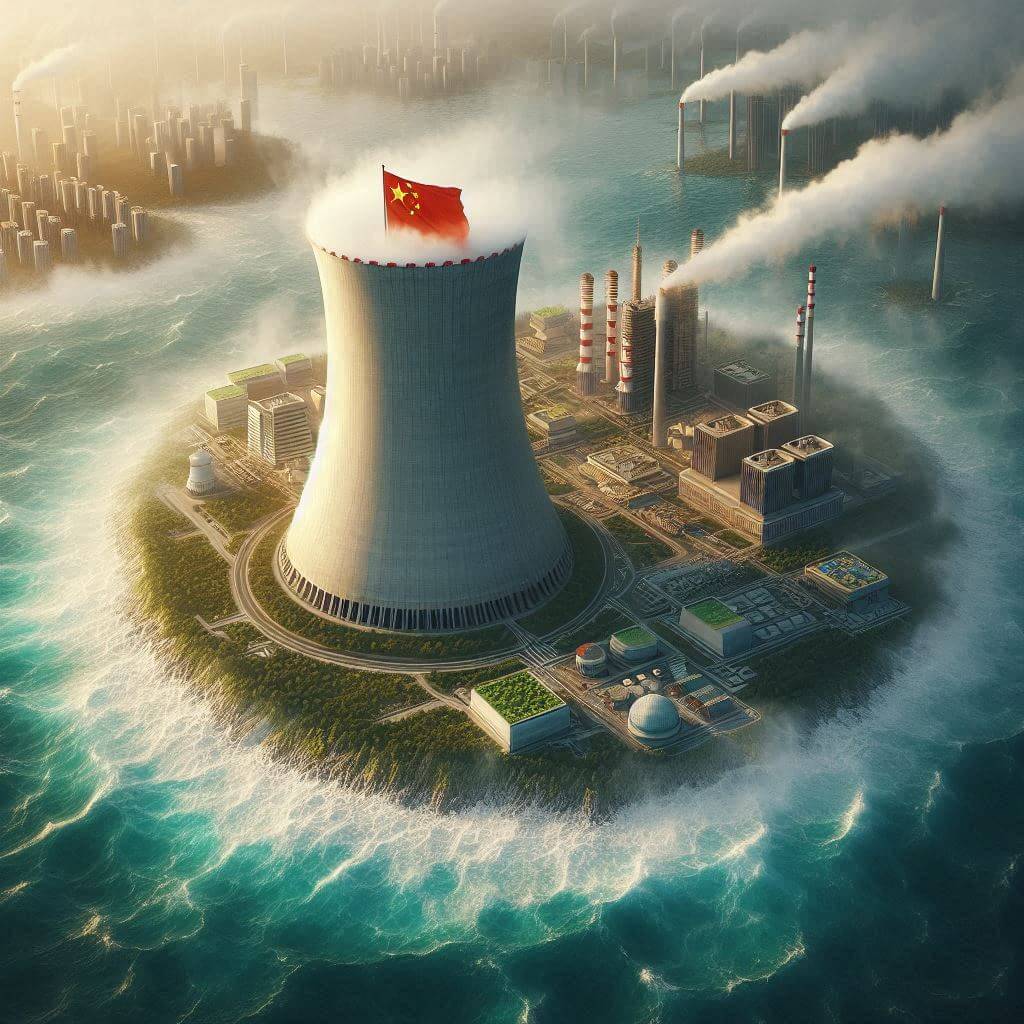
How 1000 Chinese investors learnt what they already know: Fission Energy is the next best thing.
China’s nuclear transformation is one of the most important, yet misunderstood, energy stories of the 21st century—and it was at the heart of a presentation I delivered to around one thousand Chinese investors in Hong Kong in September 2023. Speaking not as an armchair commentator but as a long‑time energy and project advisor, I argued that China’s nuclear strategy is not just an engineering program; it is a generational wealth and sovereignty project in which Chinese capital has a unique first‑mover advantage.
China’s nuclear moment
In my presentation “Hot or Not? Investing in Nuclear,” I set out the case that nuclear power is the most strategic, scalable energy platform for the 21st century and that China is positioning itself as its global champion. At the time of my talk, China operated around 55–60 nuclear units with roughly 57 GW of capacity and had declared plans to expand this to about 150 GW by 2030, a growth trajectory unmatched anywhere else in the world.
For the Hong Kong audience, many of whom were already familiar with landmark projects such as the Taishan Nuclear Power Plant, I emphasised that this expansion is not a publicity exercise but a continuation of the same disciplined, infrastructure‑led development that produced China’s high‑speed rail network—already some 40,000 km in 2023 and targeted to reach around 200,000 km by 2035. This dwarfs any other national high speed rail initiatives by orders of magnitude, Nuclear sits in that same category of long‑lived, nation‑defining assets that underpin industry, trade, and geopolitical leverage.
From 5% to the backbone of global energy
I framed China’s nuclear build‑out against the background of global energy demand and the limitations of the current system. Today’s worldwide nuclear fleet of roughly 440 reactors provides about 5% of total world energy and around 10% of electricity, a surprisingly small share given nuclear’s role in some national grids. Total world energy demand is on the order of 600 exajoules per year—about half for transport and half for electricity and heat—meaning that nuclear, at roughly 30 exajoules, is only scratching the surface of what is physically and economically possible.
I outlined a thought experiment: to supply all global energy needs with conventional solid‑fuel uranium reactors would require on the order of 10,000 large plants (1,000–5,000 MW each), or about 100,000 small modular units (100–300 MW each), numbers that sound vast until compared with the approximately 2,400 coal‑fired power stations already operating worldwide. For Chinese investors accustomed to thinking in industrial scale, this reframed nuclear not as an exotic niche, but as a realistic backbone for global energy—one where China’s early and aggressive build gives it industrial and financial leadership.
Why nuclear suits China’s model
One of the central themes of my talk was that the usual Western objections to nuclear—high costs, long build times, intractable regulation—simply do not apply in the same way in China. In the West, I noted, nuclear projects are hampered by fragmented regulation, politicised, side funded permitting, and well‑funded anti‑nuclear campaigns that funnel billions of euros and dollars annually into lobbying against fission. In China, by contrast, alignment between industrial policy, regulators, and state‑owned enterprises allows for standardised designs, repeat builds, and disciplined cost control.
I highlighted that build costs that are considered unmanageable in Europe or North America are entirely workable in China, where supply chains, project management discipline, and political commitment support serial construction. In this environment, nuclear’s economic profile looks particularly attractive: high upfront capital followed by decades of low, stable operating costs, especially for fuel. For a 5,000 MW plant, I used figures on the order of €5 million per installed megawatt, implying roughly €25 billion in capital expenditure, and then I showed how, at high capacity factors and realistic power prices, such a plant can generate multi‑billion‑euro annual cash flows over lifetimes of up to 50 years or more.
I also reminded the audience that China already has examples of nuclear assets designed for very long service lives, and that global precedent—such as U.S. plants licensed for 80 years—shows how nuclear can become a quasi‑permanent part of the industrial landscape. This combination of scale, longevity, and policy alignment makes nuclear a natural fit for China’s development model, in his view.
The logistics and fuel advantage
I devoted a notable portion of the Hong Kong presentation to the sheer physical advantage nuclear fuel offers—an advantage that plays directly to China’s strengths in logistics and large‑scale planning. He contrasted the sprawling, tanker‑heavy fossil fuel supply chain with the compactness of uranium logistics. At current consumption levels, I explained, a single large bulk carrier similar to the “Cape Ace” can carry the entire world’s annual uranium requirement. Even if the world shifted entirely to uranium‑based nuclear power, perhaps twenty such ships would suffice, compared with more than 2,000 crude oil tankers that now criss‑cross the oceans.
I also pointed out that the global uranium market is surprisingly small—on the order of only a few tens of thousands of tonnes per year and a market value of roughly single‑digit billions of euros—compared with the multi‑trillion‑dollar fossil fuel complex. Yet, because uranium is so energy‑dense, replacing the entire fossil fuel market with nuclear fuel would require annual uranium spending of perhaps around USD 140 billion, versus over USD 5 trillion spent on fossil fuels today. That translates to fuel cost savings on the order of 97% for the same delivered energy, a number that captured the attention of an audience trained to look for large, structural cost differentials.
For China, I argued, this means the opportunity to secure and manage a compact, strategic fuel supply chain, with far fewer geopolitical choke points and shipping risks than oil and gas. It also opens a long‑term industrial opportunity in enrichment, fuel fabrication, recycling, and advanced fuel cycles—fields where Chinese firms and research institutes are already active.
China and the next nuclear wave: Liquid Fission Thorium
While much of the talk acknowledged the importance of today’s solid‑fuel uranium reactors, my message to Chinese investors focused strongly on where I believe the real technological and financial upside lies: liquid fission, and especially Liquid Thorium Fission Burners.
I revisited the history of the Molten Salt Reactor Experiment (MSRE) at Oak Ridge in the 1960s, which ran successfully at around 8 MW from 1965 to 1969 and produced a comprehensive 434‑page technical report summarising more than two decades of research by tens of thousands of staff. The MSRE, I noted, was described by its own engineers as “the most boring experiment ever” because it did exactly what it was designed to do, with no surprises or crises. Yet this line of development was shut down in the early 1970s, as financial and military considerations in the United States favoured once‑through solid fuel cycles that aligns with weapons‑grade material production.
For my Hong Kong audience, the key point was not the historical injustice, but the opportunity it creates today. Technologies that were effectively “nixed” in the West are now being revived and advanced in China. I highlighted the 2 MW liquid fission Thorium machine in Wuwei, Gansu province—a modern‑era re‑run of the MSRE concept, backed by international collaboration on high‑temperature materials and corrosion‑resistant alloys developed in Australia. This project signals that China is not content to simply replicate Western light‑water reactor designs but aims to leapfrog into a new generation of reactors with inherently safer characteristics and potentially superior economics.
I also mentioned that when modern artificial intelligence systems have been tasked with designing the “best possible” nuclear machine under given constraints, they independently converge on Liquid Fission Thorium architectures similar to those pioneered at Oak Ridge in the 1960s. For investors, this convergence—between historic experimental success, current Chinese industrial capability, and modern computational design—suggests that Liquid Fission Thorium is not an exotic side bet but a likely candidate for the core of future nuclear fleets.
Safety, perception, and China’s opportunity
I did not sidestep the safety debate; instead, I sought to re-frame it for an audience whose country is still building out its nuclear fleet. I reminded investors that the three most famous nuclear incidents—Three Mile Island, Chernobyl, and Fukushima—have shaped global perception far more than they deserve based on actual casualty numbers. Three Mile Island caused zero deaths or injuries from radiation, and the remaining unit continued operating for decades after the incident – and now Microsoft is restarting it to drive it’s data centres. Chernobyl, while a serious industrial accident, resulted in on the order of a few dozen immediate deaths, and three other reactors at the same site kept running for years. Fukushima, despite the enormous social and economic disruption, did not produce any deaths from radiation exposure.
I also cited the work of radiation oncologists and researchers involved with the Chernobyl Tissue Bank who initially expected to find widespread radiation‑induced illness but ultimately found far less than feared, leading some to change their stance from anti‑ to pro‑nuclear. For China, which is designing and regulating new reactors in the 21st century rather than retrofitting mid‑20th‑century plants, this evidence base allows for a more rational, data‑driven approach to safety standards and public communication.
I argued that by building modern reactors with inherently safer designs and by basing radiation limits on empirical data rather than Cold War fears, China can avoid the extreme over‑regulation that has crippled nuclear expansion in the West. This does not mean compromising safety; it means aligning regulation with real‑world risk, thereby reducing costs and delays without accepting unacceptable hazards.
Nuclear as China’s long game
For the investors in the Hong Kong room, many of whom manage large pools of patient capital, I framed China’s nuclear strategy as part of a much larger macroeconomic and geopolitical shift. I outlined a world in which conventional oil has effectively peaked, U.S. shale is dependent on cheap debt and high prices, and Western governments face rising debt burdens and inflationary pressures as they struggle to maintain the existing energy‑financial order.
Against that backdrop, I suggested, nuclear offers China a way to secure:
- Long‑term, low‑cost, low‑carbon energy for its industries and cities.
- Strategic independence from volatile oil and gas markets.
- Exportable infrastructure and expertise in both conventional and advanced reactors.
- A platform for global influence, as other countries seek partners for their own nuclear programs.
I also noted that demographic trends in Africa and Asia—regions projected to add around two billion people between now and 2050—will drive enormous demand for reliable, affordable electricity. Nations that can offer turnkey nuclear solutions, from financing and design to fuel management and decommissioning, will play a central role in how that demand is met. China, with its existing fleet, proven build capability, and emerging leadership in liquid fission research, is well‑placed to become that provider.
In closing the Hong Kong presentation, I challenged the audience to decide whether they wished to be “following investors,” chasing crowded trades in fashionable renewables, or “foundational investors,” backing the assets and technologies that will form the bedrock of the world’s energy system for the next century. For him, the answer was clear: China’s nuclear program—especially as it moves from solid uranium to Liquid Thorium—represents one of the most consequential foundational investments of our time, and Chinese investors are sitting at the epicentre of that opportunity.
Want to see the presentation I gave and want to know about why investing into Nuclear is the best thing this side of Tuesday? Here it is. Photographic imagery courtesy of CLSA. No infringement intended, all rights belong to the respective owner.
Jeremiah
Zug, Switzerland
About the Author
Jeremiah Josey is Chairman of MECi Group, specialising in transformative energy infrastructure and advanced nuclear solutions. With a focus on thorium-based technologies, he delivers large-scale, high-value projects across the Middle East, Asia, and Australia—structuring, financing, and executing complex, multi-billion-dollar ventures that redefine the energy landscape.
Leave a Reply
You must be logged in to post a comment.