
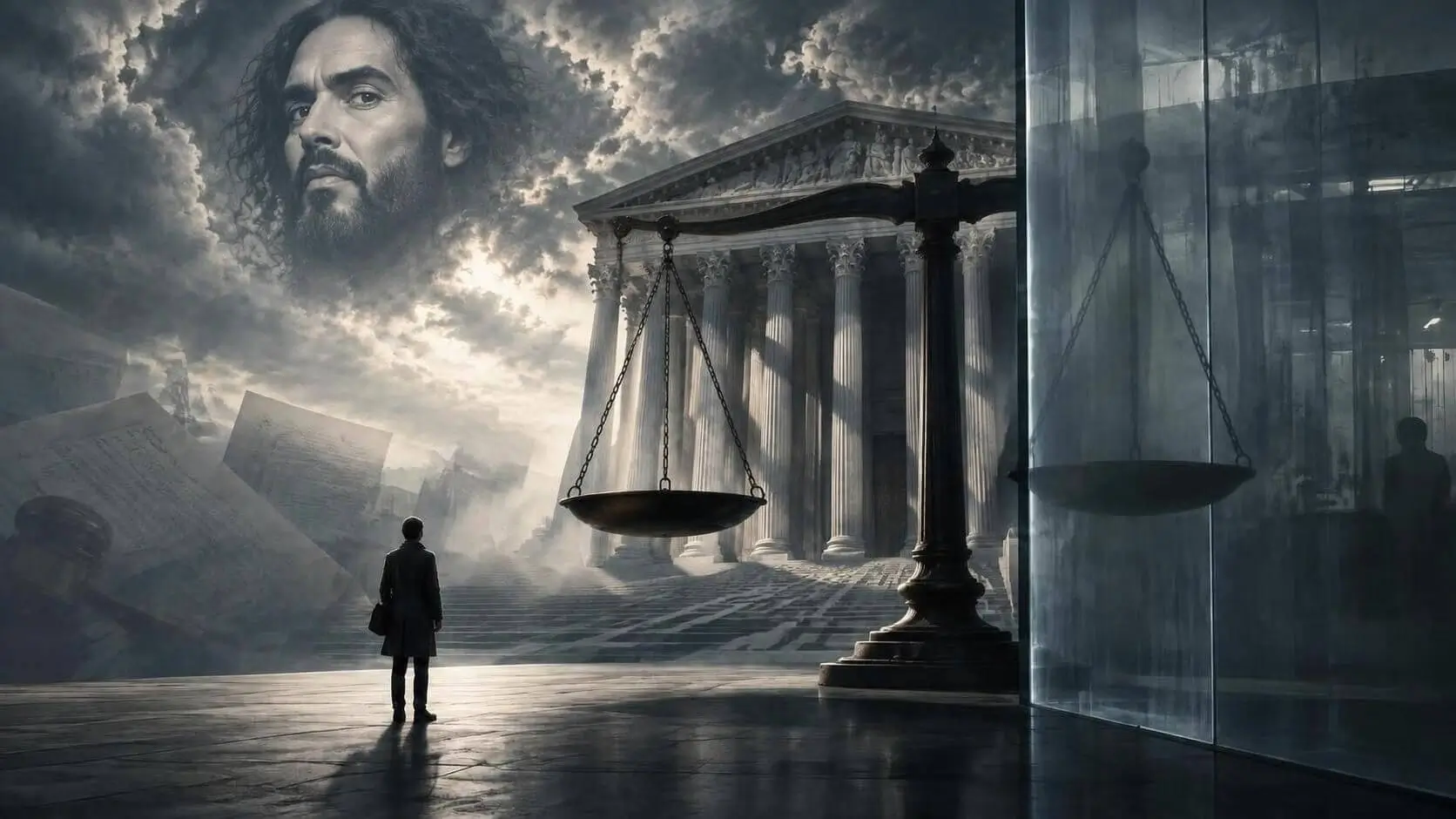
In capital markets, you learn early on to ignore the noise and watch the mechanics. Headlines are written for retail consumption; institutional moves are revealed in sequence, timing, and incentives.
When you strip away the personality, the celebrity, and the media theatre surrounding the November 2026 conviction of Russell Brand, you are left with a textbook case study in state-coordinated neutralisation.
I do not write this to defend Russell Brand’s past. He has been entirely transparent about his history of addiction and reckless behaviour during his years in entertainment—a chapter he closed over two decades ago. His personal character is not the issue here.
The issue is precedent. And if you operate, invest, or speak publicly anywhere in the Western world, the precedent set in London should have your full attention.
The Mechanics of an Institutional Takedown
True justice moves quietly through evidence, formal charges, and impartial courts. What played out over the last three years followed a completely different sequence—one that looks far more like an intelligence operation than a legal process.
- Step 1: Extrajudicial Financial Severance. Before a single criminal charge was filed, the Chair of the UK Parliament’s Media Committee wrote directly to major technology platforms demanding they demonetise Brand. Think about that. Punishment was executed before an investigation even existed. When the state pressures private infrastructure to cut off a citizen’s livelihood without due process, the courtroom becomes secondary.
- Step 2: Narrative Conditioning. When deplatforming failed to erase his reach, the framing shifted. State-aligned media aired a prime-time programme featuring anonymous accusations read by actors—at a time when zero police reports had been filed. Immediately following the broadcast, Scotland Yard issued repeated public appeals soliciting accusers for events dating back decades. They did not investigate a reported crime; they advertised for a prosecution.
- Step 3: Selective Sentencing. On 5 November 2026, a jury acquitted Brand on two counts and convicted him on a single count dating back seventeen years, relying on testimony without corroborating physical evidence. Four days later, the court handed down a sentence of ten years and six months.
Follow the Incentives
Why mobilise parliamentary committees, public broadcasters, and state resources at this scale? Because in modern governance, audience reach outside institutional control is treated as a systemic threat.
Over the past several years, we have watched trillions of pounds and dollars move through crisis-driven mandates—medical, military, and energy. When massive capital flows depend on public compliance, an independent voice capable of reaching millions across demographic lines becomes an unacceptable liability.
We have seen this exact blueprint deployed before—against Julian Assange when WikiLeaks exposed state secrets, and against independent journalists reporting outside approved boundaries. Meanwhile, in the very same jurisdiction, parliamentary inquiries have exposed industrial-scale grooming gangs operating for decades with minimal institutional urgency.
When enforcement becomes selective, the law ceases to be a shield for the citizen and becomes a weapon for the state.
Why I Am Publishing This
Publishing this note—and embedding the documentary below—is not the safest move. In an environment where algorithmic suppression and reputational attacks are standard operating procedure, silence is always the lowest-friction trade.
It is also the most expensive one in the long run.
If the state can retroactively audit a citizen’s life, bypass corroborating evidence, and synchronise media and parliamentary pressure to secure a decade-long prison sentence, then due process is no longer a right. It is a temporary licence—revoked the moment your voice becomes inconvenient.
Watch the full briefing below. Ignore the personalities, study the sequence of events, and ask yourself a simple question: If this machinery can be turned on someone with millions of witnesses, what protection does anyone else have?
Leave a Reply
You must be logged in to post a comment.