

When artificial intelligence began its rapid rise, something unexpected happened: people panicked—not just about job loss, but about losing their place, their status, their security, their belonging. The reaction was visceral, animal, primal. And it revealed something crucial: beneath every rational decision we make about strategy, culture, and organisational design, four ancient drives are running the show. Understanding them is no longer optional. It’s the difference between leading teams that crumble under pressure and teams that hold together when the world changes.
Introduction: Why We’re Still Animals
Most theories of human behaviour start too high. They begin with meaning, identity, morality, self-expression, archetypes, the unconscious, or “the self,” and then work downward. That is backward.
The cleaner starting point is animal life.
Human beings are not less animal than other animals. We are animals with language, memory, status games, coalition instincts, and the ability to build institutions that pretend to sit above instinct while actually managing it. Most of what looks noble, rational, or spiritual is usually a refined wrapper around four fundamental drives—what we’ll call the Four Keeps:
- Keep alive (material survival and resource security)
- Keep safe (threat avoidance and freedom from humiliation)
- Keep bonded (attachment, inclusion, and tribal belonging)
- Keep ranked (status, dominance, and position in the hierarchy)
These are not abstract psychological constructs. They are biological imperatives encoded into our nervous system over millions of years. Everything else—the civilisations we build, the moralities we construct, the stories we tell ourselves—is usually a variation, disguise, refinement, or compromise around these four.
This is not cynicism. It is clarity.
Part One: Why This Model Keeps Appearing

The Convergence Problem
One of the most striking facts in psychology and behavioural science is that rigorous thinkers, working from completely different traditions and with different methodologies, keep landing on roughly the same map. They use different language. They emphasise different dimensions. But the skeleton is the same.
This is not an accident. It is evidence.
Maslow’s Hierarchy: The First Successful Mapping
Abraham Maslow’s Hierarchy of Needs (1943) is often dismissed as oversimplified, and in some ways it is. But its genius was recognising that human motivation is layered, and that lower layers constrain everything above them.
Map it directly:
| Maslow’s Level | The Four Keeps | Description |
|---|---|---|
| Physiological needs | Keep alive | Food, water, shelter, sleep, basic survival |
| Safety needs | Keep safe | Security, predictability, freedom from threat |
| Belonging needs | Keep bonded | Love, friendship, family, group membership |
| Esteem needs | Keep ranked | Status, respect, recognition, achievement |
| Self-actualisation | Keep ranked (extended) | But also requires security in other keeps |
Maslow’s insight was that you cannot self-actualise—create art, pursue meaning, develop your potential—if you are starving, terrified, or socially isolated. The “higher” drives depend on the lower ones being reasonably met. That is exactly how the Four Keeps operate.
What Maslow lacked was specificity about the mechanisms and why these particular layers exist. He treated them as logical categories. But they are not logical abstractions. They are neurobiological realities shaped by evolution.
McClelland’s Three Needs: The Motivation Map
David McClelland, coming from a different direction (personality psychology and achievement motivation), identified Three Core Needs:
- Need for Achievement (the drive to accomplish, excel, and be competent)
- Need for Affiliation (the drive to be liked, connected, and part of groups)
- Need for Power (the drive to influence, lead, and control)
This is incomplete compared to the Four Keeps—it lacks the raw survival and safety dimension—but notice what McClelland found:
- Affiliation = Keep bonded
- Power = Keep ranked
- Achievement partially overlaps with Keep ranked (status through competence) and Keep alive (security through mastery)
McClelland’s research showed that people vary in the balance of these needs. Some people are driven primarily by achievement, others by connection, others by power. But all three needs appear in all healthy humans. No one has zero drive for power, and no one has zero affiliation drive. The variation is in the weighting.
This detail matters: The Four Keeps are not equal in all people or all contexts. They are universal, but their expression is not. A person in poverty is consumed by keep alive. A person in a stable career is consumed by keep ranked or keep bonded. But strip away the security, and the lower drives resurface. This is why economic stress produces such rapid behavioural change.
Self-Determination Theory: The Modern Scientific Case
Deci and Ryan’s Self-Determination Theory (developed over decades, from the 1970s onward) is perhaps the most rigorously tested motivational framework in modern psychology. It identifies three fundamental psychological needs:
- Autonomy (the sense of volition and control over one’s actions)
- Competence (the ability to master challenges and be effective)
- Relatedness (connection to others and feeling understood)
Wait—this looks different. Where is survival? Where is threat?
The key is that Self-Determination Theory was developed in contexts of relative security (schools, workplaces in developed nations). In those contexts, autonomy, competence, and relatedness are indeed the primary drivers of well-being. But what happens when autonomy is threatened? When competence is undermined? When relatedness is severed?
The organism reverts to lower levels. Self-Determination Theory does not fail—it just operates within the space where the Four Keeps are already reasonably met. It explains the texture of human motivation in contexts of relative safety. The Four Keeps explain the hierarchy beneath it.
Attachment Theory: Keep Bonded and Keep Safe from the Start
John Bowlby’s Attachment Theory, developed through observation of infants and refined across decades of research, maps cleanly onto two of the Keeps:
- Keep safe: The infant’s need for a caregiver to provide security and reduce threat
- Keep bonded: The infant’s need for proximity, consistency, and emotional responsiveness
What attachment theory shows is that these two drives are so fundamental that they shape neurobiological development in the first months of life. Infants who lack secure attachment show altered stress response, impaired learning, and difficulty with social connection throughout life.
This is not a psychological preference. It is neural architecture being shaped by the presence or absence of bonding and safety in the critical period.
The genius of attachment theory is that it reveals something crucial: The Four Keeps are not equal in their timing. Keep bonded and keep safe emerge first, in the pre-linguistic infant. Keep alive is managed by the parent but becomes self-directed later. Keep ranked emerges as a distinct drive only around age 2-3, when the child becomes aware of comparison and status.
What All These Theories Tell Us
The fact that researchers starting from completely different traditions (Maslow from humanistic psychology, McClelland from personality research, Deci and Ryan from experimental motivation studies, Bowlby from ethology and development) all converge on a similar basic structure is not a coincidence. It is a signal that they are mapping something real about how humans are built.
The Four Keeps are not a theory in the sense of a speculative model. They are a summary of a robust pattern that appears across multiple independent research traditions.
But most people do not know this convergence exists. Instead, they encounter these theories as separate, sometimes contradictory frameworks. The contribution of the Four Keeps model is to show that they are not contradictory. They are describing the same skeleton from different angles.
Part Two: The Evolutionary Logic
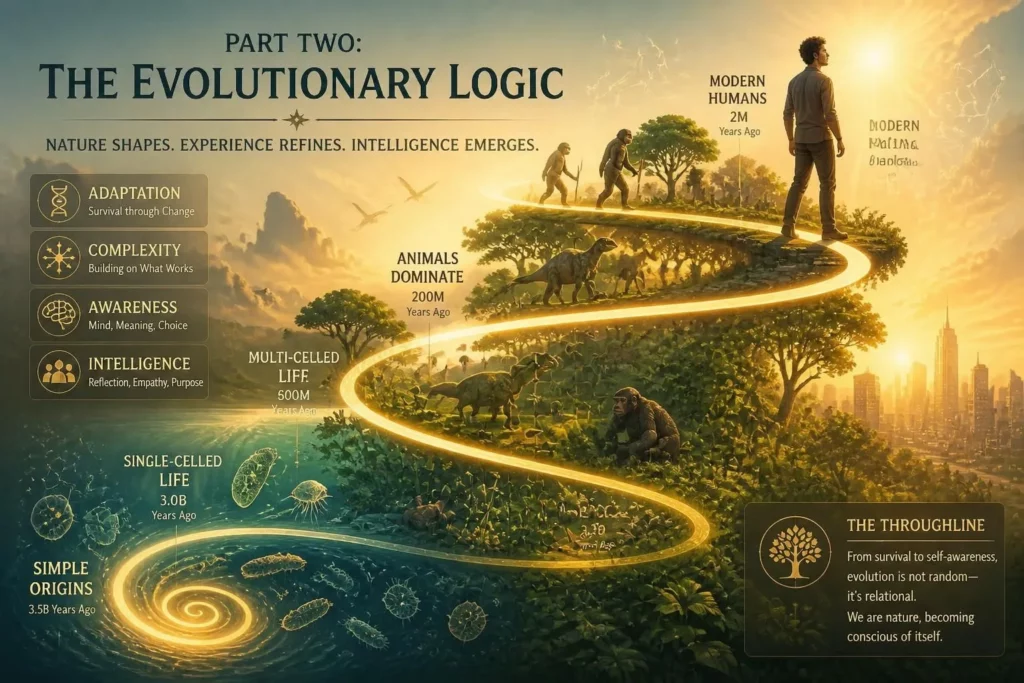
Understanding why these four drives exist requires understanding the selection pressures that created them.
The Problem Our Ancestors Solved
For the vast majority of human evolutionary history (roughly 200,000 years as Homo sapiens, and millions of years as various hominins before that), our ancestors lived in small groups—typically 20 to 150 people—in environments where survival was uncertain.
The threats were real:
- Starvation was common
- Predation happened
- Disease killed indiscriminately
- Injury was often fatal
- Other groups raided, enslaved, murdered and ate you
- Status within the group determined access to food, mates, protection, and safety
In this environment, certain behaviours became hardwired:
Keep Alive: The Substrate of Everything
Organisms that did not obsess over food, shelter, and basic resources died. Their genes disappeared.
But this is not simple. “Keeping alive” is not just individual calorie-gathering. In the ancestral environment, keep alive meant:
- Staying in a coalition large enough to hunt and defend
- Accumulating resources (tools, materials, dried meat)
- Maintaining skills (hunting, fishing, shelter-building)
- Securing access to fertile land and water
- Planning ahead for scarcity
In the modern world, keep alive translates to economic security. Money is the abstraction of resources. A person obsessed with keeping a job, maintaining income, avoiding poverty, or securing a retirement is not being primitive—they are executing an ancient program that has never stopped mattering.
The difference is the manifestation, not the drive.
Keep Safe: The Neurobiology of Threat
Humans are not the strongest animals. We cannot outrun a horse or lift like a bear. Our survival depended on detecting threats before they became lethal, and on coordinating with others to neutralise them.
This required an exquisitely sensitive threat-detection system.
The amygdala, the brain’s threat-detection organ, is proportionally larger in humans than in many other primates. It is so sensitive that it can detect fear in a face in 33 milliseconds—faster than conscious awareness. This is not a bug. It is a feature. In an ancestral environment full of lethal threats (predators, hostile groups, poisonous plants), being too cautious was rarely a disadvantage. Being insufficiently cautious meant death.
This system is so powerful and so automatic that it shapes human social behaviour in fundamental ways:
- Shame and humiliation are processed as social threats, triggering the same neural responses as physical danger
- Social exclusion activates pain circuits (the anterior cingulate cortex lights up in fMRI studies)
- Public contradiction is experienced as threat because in the ancestral context, status damage meant reduced access to resources and mates, which meant reduced reproductive success
The modern human feels humiliated in a Zoom meeting and experiences physiological stress. This is not irrational. The body is responding to what, in the ancestral context, was genuinely dangerous: status loss and potential social exclusion.
Keep safe has become far more psychological and social in the modern world, but the neural substrate is ancient and powerful.
Keep Bonded: Reciprocal Altruism and the Group Mind
Humans are the only animal that routinely survives through cooperation across non-kinship lines. We form coalitions, share knowledge, and work toward collective goals with people who are not our genetic relatives.
This is extraordinarily unusual in nature. Most animals cooperate within kinship (family) or within very short-term, immediate-payoff arrangements (schooling for protection). But humans built civilisation on the back of generalised reciprocity—I help you today without immediate return because I trust that my group will help me when I need it.
This required a drive so powerful that it could override immediate self-interest. That drive is keep bonded.
The neurobiology here is specific:
- Oxytocin (the bonding hormone) is released during physical touch, shared experience, and mutual vulnerability
- People who are socially connected have lower cortisol (stress hormone), better immune function, and longer lifespans
- Social rejection activates the same pain pathways as physical injury
In the ancestral environment, being cast out from your group was often a death sentence. A solo human, without a coalition, could not hunt large animals, defend against predators, or survive illness. Group membership was literally survival.
This drive is so strong that people will choose group membership over material security. They will leave more profitable jobs to stay in close-knit communities. They will join groups with bad incentives because the belonging feels good. They will endure humiliation to stay in a circle of friends.
This is not weakness or stupidity. It is a drive that, in the ancestral context, was often the correct decision.
Keep Ranked: Status and Reproductive Success
Within every human group that has ever existed, there is a status hierarchy. This is not a cultural invention. It is universal across human societies—forager societies, agricultural societies, industrial societies, and whatever we are building now.
Why?
Because in the ancestral environment, status correlated directly with reproductive success. High-status males had more mates and more children. High-status females had higher-quality male partners and better resources for their children. Status was not an abstract game. It was the difference between genetic representation in the next generation and genetic extinction.
This is why humans are so obsessed with status:
- Children as young as two show status sensitivity (they care who gets attention)
- Even in extremely poor groups, people expend enormous energy on relative status
- Status competitions are pervasive across all known human societies
- People will sacrifice material resources to preserve or gain status
The neurobiology is revealing:
- Winning a status competition activates dopamine systems (pleasure and motivation)
- Losing status activates the same systems as physical pain
- Observing someone of lower status succeed activates disgust centers in the brain
- Praising someone we want to rank above us activates reward circuits
These are not learned preferences. They are ancient neural programs running on ancient hardware.
In the modern world, keep ranked manifests as:
- Career competition and corporate hierarchy
- Social media status signaling
- Wealth and consumption displays
- Expertise and credentialing
- Attention and visibility
- Intellectual status
None of these existed in the ancestral environment, but they all serve the same function: establishing position in a status hierarchy.
The Cost of Transcendence
Here is a critical insight: Humans can build systems that temporarily override these drives, but the override is expensive.
When a monastery established a vow of poverty, chastity, and obedience, it was not transcending the Four Keeps. It was creating an alternative ranking system (spirituality becomes the measure of rank) that traded material security and romantic bonding for a different kind of status and belonging.
When a communist ideology promises to eliminate class hierarchy, it has not solved keep ranked—it has simply created a new hierarchy (party membership, revolutionary credentials, ideological purity) that is, if anything, more vicious because it is moral and total.
When a cult demands that members cut off their families, it has not eliminated keep bonded—it has simply redirected it entirely toward the cult, making members dependent on a single source of belonging.
The universal pattern is this: You cannot eliminate a drive. You can only redirect it, amplify it, or channel it into a different outlet.
This is why most attempts at “human transcendence” fail. They assume the drives go away. They don’t. And when you suppress them, they do not disappear—they return in stranger, more destructive forms.
Part Three: The Four Keeps in Depth
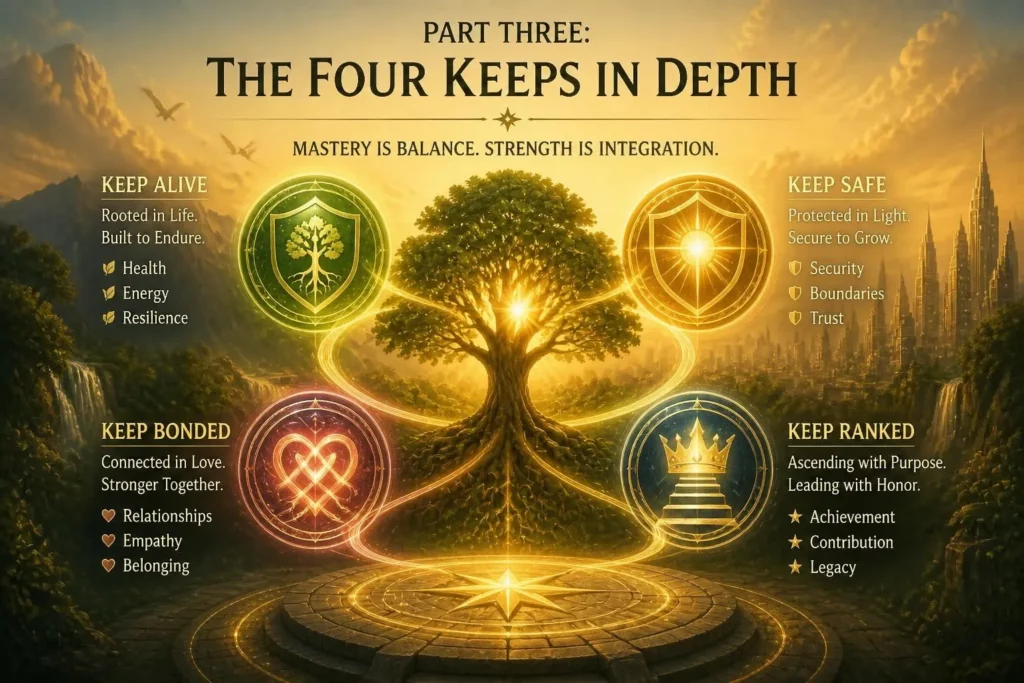
Now let’s examine each keep in granular detail, exploring how it manifests, how it gets disguised, and what happens when it is threatened.
Keep Alive: Material Security and Future Options
Keep alive is the most obvious and least contested of the four drives. Humans need food, shelter, sleep, and basic physical safety. But in the modern context, keep alive means something broader and more psychologically powerful: the secure expectation of future access to resources.
In the ancestral context, keep alive was about immediate provisioning: Do we have enough food for today? Will we be warm enough tonight? But humans also have an unusual ability to worry about the future. We can become anxious about starvation that may never come. This long-term thinking was adaptive in the ancestral context (prepare for winter, build reserves), but in the modern context it becomes chronic.
How Keep Alive Shows Up
In the workplace:
- People protect their jobs even when the job is toxic, because economic security feels more important than immediate well-being
- People avoid honest feedback because appearing weak or needing help feels like a threat to employment
- People tolerate nonsensical work, absurd meetings, and meaningless projects because these are the price of stable income
- People overwork to prove irreplaceability, not because the work requires it but because redundancy feels like potential obsolescence
- People stay in industries they hate because switching feels like financial risk
- People avoid starting their own projects because the security of a paycheck is more important than autonomy or passion
In relationships:
- People stay in relationships partly because the economic arrangement is entangled
- Spouses defer to each other to maintain the partnership because divorce means financial disruption
- People choose careers they don’t want because they need to contribute economically to family survival
- Dual-income dependency makes both partners less willing to rock the boat on other issues
In online spaces:
- People manage their reputation obsessively because reputation affects economic opportunities
- People avoid controversial statements because digital permanence means past statements can haunt future employment
- People check work messages obsessively because being unavailable feels like job risk
- People participate in performative corporate social media because it affects their professional brand
In identity:
- People define themselves by their job title or income level
- Economic anxiety drives political radicalisation
- Losing a job feels like losing identity, not just income
- People measure worth by earning potential
The Mechanism: Security as a Psychological State
Keep alive is partly material (you actually do need food and shelter) but also deeply psychological. It is the feeling of secure future access.
This is crucial: A person can have adequate material resources and still experience keep alive anxiety if they feel their position is precarious.
Consider:
- A person with USD 1 million in savings but in a declining industry feels less secure than a person with USD 100,000 in savings in a stable, high-demand profession.
- A person with stable health insurance and a 30-year mortgage feels more secure than a person with a larger income but on a one-year contract and renting.
Keep alive is not about absolute resources. It is about perceived stability and control over future access.
This perception is shaped by:
- Employment stability (contract length, market demand for your skills)
- Diversification of income (one employer vs. multiple income streams)
- Asset buffers (savings, investments, property)
- Skill transferability (can you get another job if you lose this one?)
- Social safety nets (healthcare, unemployment insurance, family support)
- Economic volatility in your industry or country
People are exquisitely sensitive to these factors. An entrepreneur earning USD 200,000 per year from an unstable startup often experiences more keep alive anxiety than an employed person earning USD 80,000 with full benefits and job security. The absolute number matters, but the trajectory and stability matter more.
Where Keep Alive Gets Disguised
“This is what professionals do” often means “this is what keeps you employed enough to stay secure.”
“I’m being responsible” often means “I’m prioritising economic security over other desires.”
“I’m being practical” often means “I’m choosing the safer financial path over the one I actually want.”
“I can’t afford to quit” almost always contains a layer of keep alive anxiety that goes beyond literal survival.
“I need to be visible and productive” often means “I need to prove my economic value so I won’t be discarded.”
The disguise works because it is partly true. There are genuinely practical reasons to maintain economic security. But the intensity of the anxiety, and the degree to which it dominates decision-making, is often disproportionate to actual risk.
A person laid off from a corporate job who panics immediately feels this vividly. They may have three months of savings, skills in high demand, and a strong network. But for the first days, keep alive anxiety is overwhelming. The body is not responding to actual scarcity. It is responding to an ancient threat: loss of group membership and economic security.
Keep Alive in Conflict with Other Keeps
Keep alive regularly comes into conflict with the other three drives:
Keep alive vs. Keep safe:
A person might stay in an emotionally abusive job because leaving feels like economic abandonment. They are sacrificing safety (freedom from threat) to maintain staying alive (economic security). This is a tragic but common bind.
Keep alive vs. Keep bonded:
A person might move away from their tight-knit community to pursue a higher-paying job. The economic security is better, but they lose connection. Or they stay in a community they’ve outgrown because leaving feels economically risky.
Keep alive vs. Keep ranked:
A person might accept a lower-status job because it pays better. Or they might take a lower salary for a higher-status position. The trade-off depends on which other keeps are threatened.
The Modern Twist: Keep Alive in the Age of Automation
In the ancestral environment, keep alive was about hunting, gathering, building, and basic provisioning. There was always work to do and always the possibility of doing it better.
In the modern world, keep alive has become dependent on scarce credentials, positional competition, and employer whim.
This has a crucial consequence: Keep alive anxiety is structurally higher in modern economies than it was in the ancestral past.
In a small hunting and gathering band, if you lost status or were temporarily excluded, you could still gather plants, fish, and help with basic provisioning. You had economic options even if you were low-status.
In a modern economy dependent on formal employment or professional credentialing, losing your job or your professional credentials can be catastrophic. There are fewer fallback options. You cannot “just go do something else” without credentials, capital, or a network.
This is why economic anxiety is a defining feature of modern life, even in wealthy countries. The structure of modern economies makes keep alive feel more precarious, even when absolute material security is higher than at any point in human history.
Keep Safe: Threat Avoidance and Freedom from Humiliation
Keep safe is about avoiding threat, punishment, retaliation, and humiliation. In the ancestral context, this was about avoiding physical danger, predators, and hostile groups. In the modern context, it is mostly about social threat: being exposed, contradicted, humiliated, or retaliated against.
This is crucial: In modern organisations and communities, social threat is processed neurologically the same way as physical threat. The amygdala does not distinguish between “someone is about to punch me” and “everyone is about to laugh at me.” Both activate threat responses.
How Keep Safe Shows Up
In meetings:
- People stay silent when they see problems because speaking up feels risky
- People offer vague language instead of direct opinions to maintain plausible deniability
- People agree with authority figures even when they disagree, because contradiction feels dangerous
- People defensively agree: “Yes, and…” rather than “No, but…”
- People wait to see where the conversation is going before committing to a position
- People soften their disagreement with layers of politeness that muddy the actual point
In feedback and conflict:
- People avoid giving critical feedback even when it would help, because criticism feels like an attack
- People frame criticism as gentle suggestions (“have you considered…” rather than “this is wrong”)
- People hide mistakes instead of reporting them, trying to fix problems secretly
- People escalate complaints quietly to authority rather than addressing them directly with the person involved
- People ruminate about conflicts rather than resolving them, because resolution feels risky
In relationships and groups:
- People ghost instead of having difficult conversations
- People stay in bad relationships because breaking up feels scary and uncertain
- People leave groups quietly instead of disagreeing and staying
- People perform agreement through laughter, head-nodding, and emoji reactions
- People share controversial opinions only with trusted people, not in public forums
In professional identity:
- People develop a “professional persona” that is more controlled and defensive than their actual personality
- People censor their thoughts in writing because written records feel more permanent and damaging
- People avoid being the first to speak in meetings because first speakers are most exposed to contradiction
- People avoid presenting ideas until they are bulletproof, missing the value of early feedback
- People cultivate allies and political capital specifically to defend against future retaliation
In online spaces:
- The permanent, searchable nature of digital speech triggers keep safe anxiety at a level that did not exist when speech was ephemeral and local
- People perform carefully curated versions of themselves
- People delete and second-guess messages before sending
- People monitor their digital footprint obsessively
- Dogpiling and call-out culture intensify keep safe anxiety
- Anonymity becomes appealing precisely because it removes the threat of personal retaliation
The Neurobiology of Social Threat
The key to understanding keep safe in the modern context is recognising that shame, humiliation, and social exclusion activate the same brain regions as physical pain and threat.
This is not metaphorical. In functional MRI studies:
- Social rejection activates the anterior insula and anterior cingulate cortex, the same regions activated by physical pain
- Being contradicted in public activates the amygdala (threat detection) before conscious awareness
- Observing someone’s embarrassment activates mirror neurons, making you feel their shame
- Status loss activates the same dopamine systems as reward loss
This means that a person who experiences public contradiction experiences it as a genuine threat, not as a social inconvenience. Their body is in a threat state. The heart rate increases, stress hormones release, and the prefrontal cortex (rational thinking) goes partially offline.
This is adaptive in some contexts. If you are in a hostile environment where social exclusion means death, then being exquisitely sensitive to social threat is useful.
But in a modern workplace or community, this threat response often misfires:
- A boss asks a critical question about your work, and you experience it as an attack (threat response)
- A colleague disagrees with your idea, and you experience it as a challenge to your competence and status (threat response)
- You make a mistake in a meeting, and you experience humiliation (threat response)
- Someone unfollows you on social media, and you experience rejection (threat response)
The intensity of these reactions is disproportionate to actual danger. But the neural response is real.
Keep Safe in Organisational Dynamics
Perhaps nowhere is keep safe more consequential than in organisational life. Organisations are built on hierarchies and interdependence, which means:
- You are dependent on people with power over you (your boss)
- Your mistakes are potentially observable (meetings, code reviews, performance reviews)
- Your future (raises, promotion, retention) depends on others’ evaluation
- Your status is always somewhat precarious
In this context, keep safe anxiety becomes the dominant driver of behaviour.
The silence spiral: When someone gets punished for honest feedback (publicly corrected, demoted, or fired for dissent), the entire organisation learns the lesson. Speaking up is dangerous. From that point on, people stay silent even when they see problems. The organisation loses its early-warning system for problems that could have been prevented.
The defensive posture: People develop elaborate systems to protect themselves:
- Documentation of everything (so you have records proving you were not responsible for failures)
- Busyness and visibility (so people know you are working hard)
- Alignment with power (so you are protected by association)
- Passing information privately rather than in groups (so you control who knows what)
- Under-commitment (saying “I’ll try” rather than “I will”) to avoid being held accountable
All of these make organisations slower, less transparent, and less effective.
The honesty tax: In organisations with high keep safe anxiety, honesty becomes expensive. If you admit a mistake, you risk consequences. If you admit ignorance, you risk looking incompetent. If you acknowledge a problem you did not cause, you risk being blamed for it.
So people become strategically vague, pass problems up the hierarchy without context, and document their innocence rather than solving problems.
The political layer: In high-keep safe environments, every decision becomes political. It is not “what is the right decision?” but “what decision protects me?” This adds a second game on top of the actual work. Two smart people discussing a decision are not just analysing the decision—they are also positioning themselves relative to other stakeholders, considering how the decision will affect their status, and anticipating how it will be weaponisd later.
This is exhausting and often invisible to people who are in psychologically safe environments. If you work somewhere you trust the leadership, where mistakes are treated as learning opportunities, and where people are genuinely trying to solve problems rather than protect positions, you may not realise how much energy people in other organisations spend on the keep safe dimension.
Where Keep Safe Gets Disguised
“I’m being professional” often means “I’m hiding my actual thoughts to avoid threat.”
“I want to be respectful” often means “I’m afraid that directness will be punished.”
“Let me think about that” often means “let me figure out what is safe to say.”
“I’m just being cautious” often means “I’m prioritising threat avoidance over progress.”
“I don’t want to be negative” often means “I’m afraid that criticism will damage my relationships or status.”
“I’m protecting their feelings” sometimes is genuine care, but sometimes is “I’m protecting myself from their reaction.”
The disguise is powerful because the underlying anxiety is real and often justified. Many organisations do punish honesty. Many groups do retaliate against dissent. Many hierarchies do use information as a weapon.
But when keep safe anxiety becomes the dominant driver, it paralyses organisations. People become unable to think clearly because they are constantly threat-scanning.
Keep Safe in Conflict with Other Keeps
Keep safe vs. Keep alive:
A person might leave a lucrative job because the environment is so threatening that their psychological health is suffering. They are trading economic security for psychological safety.
Keep safe vs. Keep bonded:
A person might isolate themselves from a group they care about because the group has become hostile or judgmental. They are sacrificing belonging for safety.
Keep safe vs. Keep ranked:
A person might stay quiet in a meeting where they could claim credit or establish expertise because speaking up feels risky. They are sacrificing rank for safety.
Keep Bonded: Attachment, Inclusion, and Tribal Belonging
Keep bonded is the drive to be inside the circle, not outside it. It is the need for attachment, inclusion, loyalty, and the sense that you matter to a group.
In the ancestral context, being excluded from your group was often a death sentence. Humans are weak individually and strong collectively. A solo human without a coalition could not hunt large animals, could not defend against predators or hostile groups, and faced severe disadvantages in finding a mate.
This created a drive so powerful that it often overrides self-interest. People will choose belonging over material security, safety, or even basic hygiene. They will join groups with bad incentives, tolerate humiliation, sacrifice privacy, and ignore red flags—all to maintain the feeling of being inside.
How Keep Bonded Shows Up
In groups and communities:
- People laugh at jokes that are not funny because laughter is a bonding signal
- People participate in group rituals and traditions even when they find them pointless
- People adopt group opinions and aesthetic preferences, sometimes without realising they are doing it
- People check in casually with group members (“how’s your day?” on Slack) even when they have no substantive communication
- People mirror the tone, vocabulary, and concerns of their group
- People suppress individual preferences to align with group consensus
- People stay in groups that have become dysfunctional because the sunk cost of belonging feels too high to leave
- People spend hours in chats, forums, or communities not because they are getting value but because they are afraid of missing the connection
In families:
- People stay in contact with toxic family members because the biological and cultural pull of family bonding is so strong
- People sacrifice their own goals and well-being to maintain family loyalty
- People perform family roles (the responsible one, the funny one, the successful one) even when these roles no longer fit
- People hide important life decisions from family to avoid conflict, maintaining a false version of themselves
- People return to family dynamics and childhood patterns even as adults
In romantic relationships:
- People stay in relationships partly because of the bonding attachment itself, separate from whether the relationship is functional
- People perform sexual, emotional, or domestic labor to maintain bonding even when resentful
- People hide or downplay friendships and outside interests to prioritise couple bonding
- People become codependent, losing individual identity in service of the relationship
- People remain in contact with exes not because they want to but because the bonding urge is strong
In online communities:
- People maintain membership in toxic online groups because the social identity and belonging feel more important than the content or purpose
- People become addicted to specific forums, Discord servers, or group chats not because the content is valuable but because the pattern of interaction and belonging is rewarding
- People perform extreme loyalty to online figures or communities (parasocial relationships)
- People defend groups they belong to even when presented with evidence of wrongdoing
- People perform fake agreement and enthusiasm to maintain status within the group (emoji reactions, enthusiastic comments, etc.)
In professional contexts:
- People adopt corporate culture and values, sometimes becoming true believers and sometimes cynically performing belief
- People stay at companies far longer than makes sense for their career because the social bonds feel important
- People prioritise team loyalty over individual advancement
- People adopt the priorities of their team even when they conflict with their own judgment
- People go along with group decisions they disagree with to maintain team cohesion
In political and ideological contexts:
- People adopt entire belief systems partly because they want to belong to a group that holds those beliefs
- People perform ideological loyalty and attack people who question the group’s orthodoxy
- People become more extreme in their views when surrounded by like-minded people (group polarisation)
- People maintain beliefs even when presented with contradictory evidence because changing beliefs would mean leaving the group
The Neurobiology and Evolution of Bonding
Keep bonded is neurobiologically specific. It involves:
- Oxytocin release during physical touch, shared experience, and mutual vulnerability, which creates pleasure and trust
- Mirror neurons that activate when we observe others, making us literally feel what they feel
- Dopamine rewards for social cooperation and status within the group
- Pain pathways activated by social rejection (literal physical pain from exclusion)
This bonding system evolved because generalised reciprocity—working with non-relatives toward shared goals—is the secret sauce of human success.
No other animal does this at scale. Ants cooperate but are genetic clones. Wolves cooperate but within kinship and short-term hierarchies. Humans cooperate with strangers, at scale, across generations, without genetic incentive.
This required a bonding system powerful enough to override immediate self-interest. You help me today. I help you tomorrow. Neither of us has the genetic incentive to help the other (you are not my relative), but we both benefit from the reciprocal arrangement.
This system is so powerful that it is the foundation of civilisation. All human institutions—families, tribes, companies, nations, churches, sports teams—are built on keep bonded drives binding people together.
But because the system is so powerful, it is also easily exploited.
The Dark Side of Keep Bonded
Keep bonded is one of the most beautiful drives—it creates friendship, love, loyalty, and the possibility of building things together that are larger than individual interest.
But it is also one of the most dangerous, because people will tolerate extraordinary abuse to maintain bonding.
In cults:
Members stay in groups led by abusive leaders, give away their resources, and cut off their families because the group provides intense bonding and a sense of belonging and meaning.
In abusive relationships:
People stay with partners who hurt them because the bonding attachment is so strong, and because isolation (the alternative) feels like death.
In toxic teams:
People stay in jobs with terrible work, poor pay, and toxic colleagues because the team identity and bonding are strong enough to override logic.
In online hate groups:
People join communities organised around hating an outgroup partly because of the bonding and identity with the ingroup, creating a form of belonging that would be hard to find elsewhere.
In political and religious communities:
People adopt beliefs they would not naturally hold and perform behaviours they would not naturally engage in because the bonding and belonging to the community is more important than truth.
Where Keep Bonded Gets Disguised
“I’m being loyal” often means “I’m prioritising the group over my own judgment or well-being.”
“We’re like a family” often means “I’m using bonding language to create obligation and suppress individual interest.”
“This is what friends do” often means “I’m using friendship to extract behaviour that would not be freely given otherwise.”
“I just want to feel included” contains the raw honesty of the drive, but the lengths people go to achieve it are often destructive.
“Community is everything” can mean genuine connection, but can also mean “the group’s interests override individual boundaries.”
The key insight is that keep bonded is often the reason people tolerate other terrible conditions. A person might stay in a low-paying job because the team feels like family. A person might stay in a community that does not serve them because leaving feels like betrayal. A person might adopt beliefs they don’t hold because the cost of disagreement is social exile.
This is not weakness. It is a powerful drive doing what it was designed to do: keep you in the group even when individual self-interest says leave.
Keep Bonded in Conflict with Other Keeps
Keep bonded vs. Keep alive:
A person might leave a lucrative job in a different city to stay with their family and community. They are sacrificing economic security for bonding.
Keep bonded vs. Keep safe:
A person might stay in an emotionally abusive family relationship because the bonding is still strong, even though safety is compromised.
Keep bonded vs. Keep ranked:
A person might stay with friends who are holding them back from advancement, or leave a friend group when one person gets status and becomes insufferable. The trade-off depends on which drive is stronger in that moment.
Keep Ranked: Status, Dominance, and Position in the Hierarchy
Keep ranked is the drive to be higher in the hierarchy than others—or at least not at the bottom. It is the obsession with status, dominance, prestige, influence, and position.
In the ancestral environment, status determined access to resources, mates, and security. High-status males had more mating opportunities and more resources to support their children. High-status females had access to better male partners and more resources. Status was not an abstract game. It was directly linked to reproductive success.
This created a drive so powerful and so automatic that humans spend enormous energy managing their status relative to others, often without conscious awareness.
How Keep Ranked Shows Up
In conversation and meetings:
- People interrupt to establish they have something important to say
- People speak first to establish authority before others do
- People speak with certainty and confidence even when uncertain, because tentativeness reads as low status
- People name-drop (mentioning important people they know) to borrow status from association
- People correct others to establish expertise and superiority
- People tell stories where they are the protagonist who solved a problem, rather than admitting they needed help
- People take credit for group work and minimise others’ contributions
- People speak longer and more frequently, taking up more conversational space
- People interrupt women more than men, and low-status people more than high-status people
In professional contexts:
- People obsess over job titles, organisational charts, and reporting structures
- People fight for visibility—getting credit, being in important meetings, having their name on projects
- People manage their professional brand obsessively
- People establish expertise and gatekeep knowledge to maintain status
- People build alliances and coalitions to defend their position
- People monitor who gets praised, promoted, and paid more, constantly comparing themselves
- People position themselves as the “real owner” of projects and ideas
- People subtly undermine competitors
- People perform busyness and importance to signal status
- People consume status symbols: nice offices, titles, salary, prestigious credentials
In social hierarchies:
- People establish pecking order through teasing and joking that has an edge of dominance
- People remember who deferred to them and who challenged them
- People treat high-status people with more deference and respect
- People treat low-status people with less attention and politeness
- People monitor their relative position to peers obsessively
- People perform high-status behaviours: confidence, decisiveness, control over resources and information
- People perform low-status behaviours: deference, agreement, taking up less space
- The same person might be high-status in one context and low-status in another, and will adjust their behaviour accordingly
In consumption and display:
- People buy status symbols: designer clothes, luxury cars, prestigious addresses, expensive hobbies
- People cultivate aesthetic and cultural preferences that signal refined taste and high status
- People pursue credentials (degrees, certifications, awards) partly for the status signaling
- People post on social media to display status and attract admiration
- People judge others partly by these status signals and are judged similarly
In online spaces:
- People compete for attention, likes, shares, and comments
- People develop follower counts as a status metric
- People perform expertise and authority to gain status
- People call out others’ mistakes to establish superiority
- People form hierarchies even in supposedly egalitarian spaces
- People perform status through aesthetic choices, language, cultural references
In intellectual and ideological spaces:
- People defend their ideas not because they are true but because admitting error means status loss
- People adopt contrarian positions partly because contrarianism is a status signal (I am smart enough to see what others miss)
- People perform intellectual sophistication through complex vocabulary and references
- People establish in-group status hierarchies based on ideological purity
The Neurobiology of Status
Status is neurobiologically powerful. Winning a status competition activates dopamine (the motivation and pleasure neurotransmitter). Losing status activates pain pathways and stress responses.
But here is what is fascinating: The dopamine hit is not from the material reward. It is from the status itself.
Research shows that:
- A person who gets a raise experiences dopamine activation
- But if everyone else got a bigger raise, they experience disappointment despite absolute material improvement
- A person who is promoted feels pleasure
- But if a peer is promoted higher, the pleasure is diminished
- People will sacrifice material resources to gain status
- People experience physical pain when losing status
This is relative, not absolute. Your brain does not care primarily about your absolute position. It cares about your position relative to your reference group.
This has profound implications:
- A person making USD 200,000 in a group of people making USD 250,000 feels poor and low-status
- A person making USD 80,000 in a group of people making USD 60,000 feels rich and high-status
- The absolute difference in material security might be minimal, but the psychological difference is enormous
This is why:
- Inequality creates anxiety even when everyone’s absolute standard of living is improving
- People move to wealthy neighborhoods and then feel poor relative to their neighbors
- Peer comparison is more important than absolute conditions in determining happiness
- Social media, which makes peer comparison constant and global, creates epidemic-level status anxiety
The Status Hierarchy in Organisations
Organisations are status hierarchies. Even organisations that claim to be egalitarian or flat develop status hierarchies—they just become invisible and thus more vicious.
In an explicit hierarchy (traditional org chart), status is clear:
- The CEO is highest status
- Directors are high status
- Managers are middle status
- Individual contributors are lower status
- Interns are lowest status
Everyone knows where they stand. There is competition for advancement, but the structure is transparent.
In a “flat” or “egalitarian” organisation, the status hierarchy does not disappear. It becomes based on:
- How much influence you actually have
- Whose ideas get implemented
- Who gets listened to in meetings
- Who mentors whom
- Who sets the agenda
- Whose work is praised
This invisible hierarchy is often more competitive and more brutal than an explicit one because:
- People cannot see the rules, so they cannot navigate them strategically
- Status competition is denied (“we’re all equal”) while being intense
- Coalitions and political maneuvering become the primary way to establish status
- People feel betrayed when they discover the hidden hierarchy
The most functional organisations often have explicit hierarchies with clear roles and advancement paths, because this channels keep ranked energy into productive competition rather than invisible political games.
Where Keep Ranked Gets Disguised
“I’m just being professional” often means “I’m performing high-status competence and confidence.”
“I’m trying to help” sometimes means “I’m offering advice so I can position myself as expert.”
“Someone needs to take ownership” often means “I want to be seen as the responsible one.”
“I want to make sure we get credit” often means “I’m protecting my status.”
“I’m being strategic” often means “I’m thinking about status implications.”
“I’m just speaking up” sometimes means “I’m trying to establish expertise and authority.”
“I want to be heard” contains some raw honesty about the keep ranked drive.
The disguise is powerful because status ambition is often seen as selfish or unseemly. So people dress it up in language about responsibility, competence, fairness, or necessity. But underneath, they are managing their position in the hierarchy.
Keep Ranked in Conflict with Other Keeps
Keep ranked vs. Keep alive:
A person might take a lower-paying, higher-status job because status feels more important than material security.
Keep ranked vs. Keep safe:
A person might speak up in meetings to establish expertise, even though silence would be safer. They are sacrificing safety for rank.
Keep ranked vs. Keep bonded:
A person might criticise a friend to establish intellectual superiority, damaging the friendship. They are sacrificing bonding for rank. Or conversely, they might stay silent to protect the friendship.
Part Four: How the Four Keeps Get Disguised
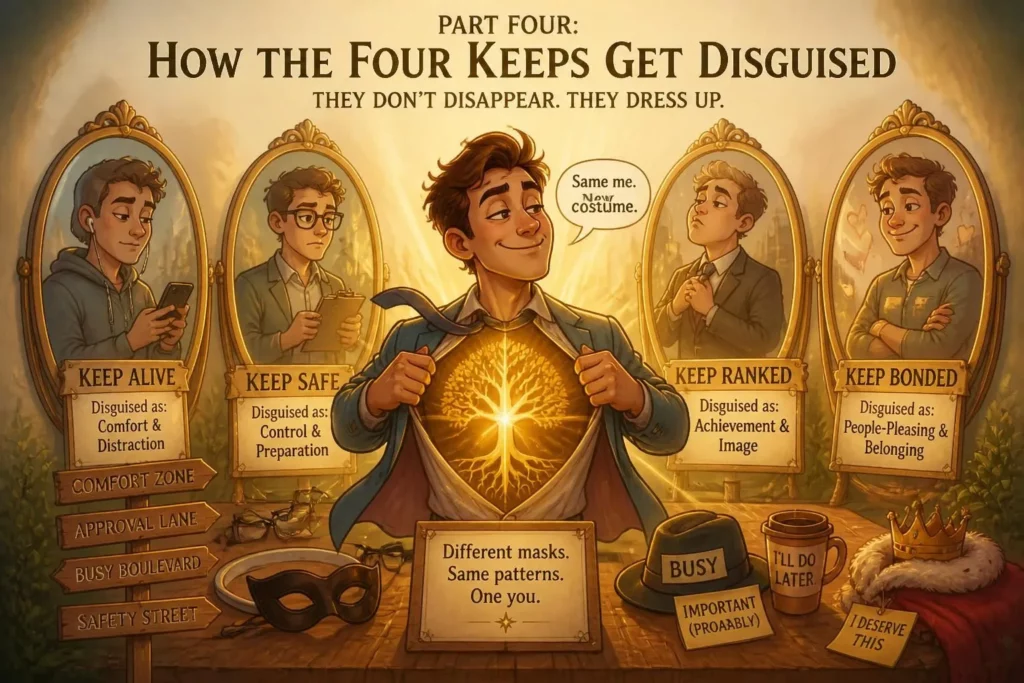
The key insight is that most human “higher” behaviour is one drive wearing the mask of another. We experience our actions as driven by noble motivations, but often the substrate is one (or more) of the Four Keeps.
I’m not being cynical. I’m being clear.
The Disguise Mechanism
When we say “I did this out of love” or “I did this because it was the right thing,” we are usually not lying. But we are often incomplete in our self-understanding.
A mother sacrifices her career for her children. This is genuinely love and bonding (keep bonded). But it also involves keep safe (protecting her children from threat) and keep ranked (the status of being a good mother). The love is real, but it is not simple.
A man donates money to charity. This is genuinely compassion and moral conviction. But it also involves keep ranked (status as a generous person), keep bonded (feeling connected to the community), and possibly keep alive (reducing the threat of social disruption that poverty creates). The compassion is real, but it is multidetermined.
An employee works late to finish a project. This is genuinely commitment and conscientiousness. But it also involves keep alive (proving economic value), keep safe (avoiding the threat of being seen as uncommitted), and keep ranked (establishing oneself as dedicated and responsible). The commitment is real, but it is embedded in the Four Keeps.
The Common Disguises
Here are the most common ways the Four Keeps get translated into “higher” language:
| What People Say | The Underlying Keep | What Is Actually Happening |
|---|---|---|
| Love | Keep bonded + Keep safe | Attachment and protection, sometimes presented as transcendent but always embedded in bonding drives |
| Duty | Keep bonded + Keep safe | Obligation to groups and fear of rupture |
| Morality | Keep ranked + Keep bonded | Group-order maintenance and status signaling through righteousness |
| Professionalism | Keep alive + Keep safe + Keep ranked | Controlled obedience to maintain employment, avoid threat, and establish status |
| Respect | Keep ranked | Acknowledgment of superior status |
| Faithfulness | Keep bonded + Keep safe | Attachment protected by rules and fear of loss |
| Leadership | Keep ranked + Keep alive + Keep bonded | Status with a story attached; the ability to direct others’ resources and labor |
| Service | Keep ranked (inverted) + Keep bonded + Keep alive | Status surrender in exchange for belonging or material security |
| Sacrifice | Keep bonded + Keep ranked | Performing commitment to group; signaling loyalty status |
| Ambition | Keep alive + Keep ranked | Material security plus status advancement |
| Integrity | Keep ranked + Keep safe | Status as a person of principles; safety through predictability |
| Loyalty | Keep bonded + Keep safe | Attachment plus fear of consequences of disloyalty |
| Courage | Keep ranked + Keep safe | Overriding threat response to gain status |
| Humility | Keep bonded + Keep ranked (inverted) | Status through appearing not to seek status |
| Authenticity | Keep bonded + Keep ranked | Being “real” to maintain belonging and to signal high status through not needing to pretend |
None of these are fake. They are all real experiences and real motivations. The point is that they operate within the frame of the Four Keeps, not above it or beyond it.
The Stacking of Keeps
One of the most important insights is that the Four Keeps often operate simultaneously, supporting and sometimes contradicting each other.
Example: Career Ambition
A person pursues a demanding career. Let’s untangle what is actually happening:
- Keep alive: The person wants to secure income and long-term financial stability
- Keep safe: The person wants the security of a stable, prestigious career that cannot be easily challenged or devalued
- Keep bonded: The person might want to impress their family, earn the respect of colleagues, or belong to a high-status professional community
- Keep ranked: The person wants status, title, influence, and recognition
All four are present. The person experiences it as ambition and drive, but each of the Four Keeps is pushing them forward. If any one of them is threatened, the person’s motivation might shift.
If the career becomes financially unstable (keep alive threatened), the person might stay for keep ranked reasons.
If the career becomes emotionally toxic (keep safe threatened), the person might stay for keep alive or keep bonded reasons.
If the person’s family needs them (keep bonded threatened), they might sacrifice career for family.
Example: Relationship Commitment
A couple has been together for 15 years and has built a life together. Why do they stay?
- Keep alive: Their financial arrangements are entangled. Divorce would be costly and disruptive
- Keep safe: The predictability of a long-term relationship is reassuring; the unknown of being single is threatening
- Keep bonded: They genuinely love each other and have deep attachment
- Keep ranked: They have status as a couple; there is pride in the long-term commitment
If the relationship becomes hostile (keep safe threatened), the keep alive entanglement and keep bonded attachment might still keep them together, but the motivation would be mixed.
If one person becomes famous or successful (keep ranked dramatically improved), they might be tempted to leave for someone who matches their new status level.
If one person loses income (keep alive threatened), they might become dependent on the other, intensifying keep alive fear.
The Illusion of Transcendence
One of humanity’s most consistent moves is to believe that we have transcended the animal drives through culture, spirituality, philosophy, or evolution.
Religions promise transcendence of animal nature through spiritual discipline. Philosophies promise transcendence through reason. Psychology promises transcendence through self-awareness. Political ideologies promise transcendence through restructuring society.
But transcendence never actually works.
What happens instead is redirection and reorganisation.
A monastic order does not eliminate the Four Keeps. It reorganises them:
- Keep alive is managed by the community (the monastery provides food and shelter)
- Keep safe is achieved through the rules, the community’s protection, and the security of a defined role
- Keep bonded is intensified and redirected toward the monastic community and toward God (parasocial bonding)
- Keep ranked is reorganised around spiritual achievement (holiness, purity, closeness to God, seniority in the order)
The monks experience this as transcendence. They have moved beyond material concerns. But they are still operating within the frame of the Four Keeps. They have just created a system where those drives are channeled differently.
Similarly, a communist ideology promises to eliminate class hierarchy and status competition. But every communist state developed elaborate hierarchies based on party membership, revolutionary credentials, and ideological purity. Keep ranked never went away. It just got more total and more ideologically justified.
The key principle: You cannot eliminate a drive. You can only redirect it, suppress it (at great cost), or channel it into a different outlet.
This is why most attempts at “human transcendence” fail. They assume the drives disappear. They don’t. And when you suppress them, they do not vanish quietly. They return in stranger, more destructive forms.
Part Five: The Four Keeps in Real Teams and Organisations
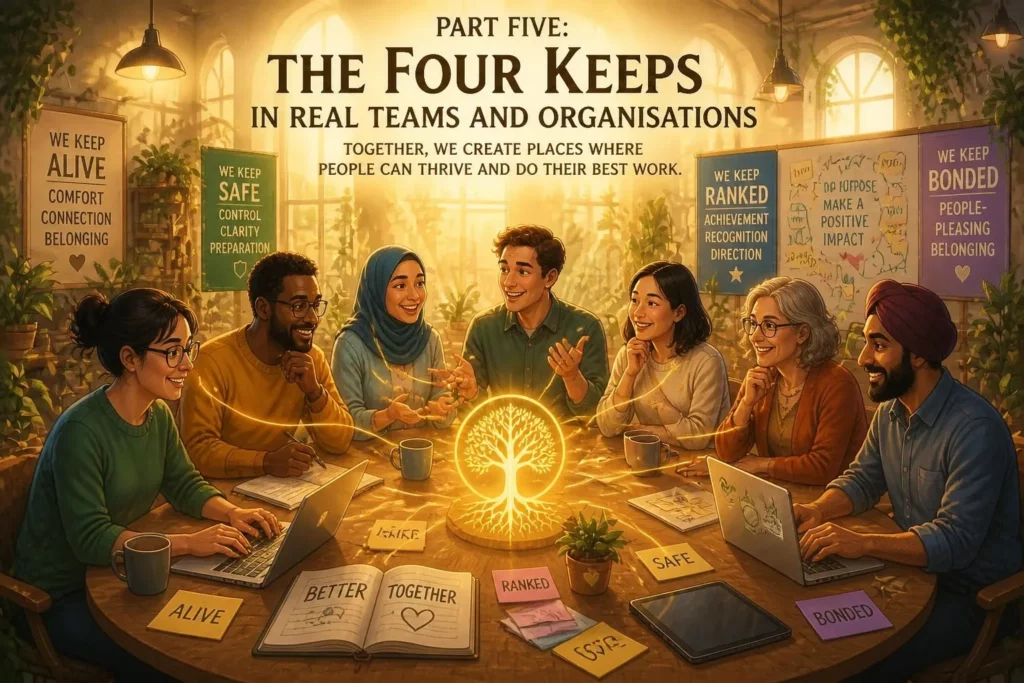
Now let’s see how this framework actually plays out in realistic organisational contexts. The abstract model becomes concrete when you watch it operate in Slack channels, Zoom calls, org charts, and team dynamics.
The Team Formation Phase
When a team comes together, people immediately begin navigating all four keeps.
Keep alive: People are evaluating whether this team will be stable, whether it will affect their employment security, and whether the role comes with material security.
Keep safe: People are figuring out the norms. What can you say? What gets you punished? Who is safe to disagree with? How permanent are your statements (written Slack vs. verbal)?
Keep bonded: People are trying to find their place in the group, figure out who to align with, and establish initial bonds.
Keep ranked: People are establishing initial status. Who speaks first? Who gets deferred to? Who has power? Who is peripheral?
A healthy team formation phase allows all four to settle:
- People feel materially secure (keep alive)
- People feel they can speak honestly without excessive threat (keep safe)
- People develop bonds and feel they belong (keep bonded)
- Status hierarchies form and are accepted (keep ranked)
An unhealthy team formation phase leaves one or more of these unsettled. For example:
- If keep alive is uncertain (the team might be shut down, the project might be defunded), people are anxious and unable to focus on work. They start looking for escape routes instead of investing in the team.
- If keep safe is uncertain (the leader is unpredictable, mistakes get punished, disagreement is dangerous), people become defensive. They stop speaking honestly and start managing impressions. Information becomes weaponised.
- If keep bonded is uncertain (there are cliques, people feel outside, the group feels fractured), people feel isolated. They may form sub-groups or coalitions for protection, which further fragments the team.
- If keep ranked is uncertain (the hierarchy is ambiguous, status is constantly contested, power dynamics are unstable), people compete constantly. Energy goes into positioning rather than work.
The fascinating thing is that teams often appear calm when the Four Keeps are unsettled. People who are navigating high threat or high uncertainty are often quiet. They are threat-scanning, not speaking. The silence gets mistaken for harmony, when it is actually the silence of anxiety and self-protection.
The Unhealthy Team Formation: The Hidden Sorting
When a team forms in high-threat or uncertain conditions, something predictable happens: hidden sorting by threat sensitivity, loyalty, and status seeking.
People immediately ask: “Who in this group will protect me?” “Who poses a threat?” “Who can help me survive?”
This creates invisible coalitions that the official team structure does not recognise:
- The safety-seeking group finds who is trustworthy and stays close to them, avoiding others perceived as dangerous.
- The loyalty-seeking group aligns with whoever seems most powerful or secure, deferring to their judgment.
- The status-seeking group competes to establish position, watching who gets credit and who gets blamed.
- The bonding-seeking group tries to befriend everyone but is secretly monitoring who reciprocates and who excludes them.
These invisible coalitions are toxic because:
- They create parallel information networks (real discussions happen in private Slack channels, not in meetings)
- They make decision-making political instead of meritocratic (what’s best for the group vs. what protects my coalition)
- They prevent honest feedback because feedback might be used as a weapon by rival coalitions
- They make disagreement dangerous because it can be interpreted as disloyalty
The team’s official culture might be “collaborative” and “flat,” but the actual operating system is tribal, political, and status-conscious. And because this is all happening below the surface, it is nearly impossible to address directly. If you name the coalitions, you risk further fragmentation.
Leadership: Making the Four Keeps Workable
The primary job of a leader is not to eliminate the Four Keeps. That is impossible. The job is to make them workable—to lower unnecessary threat and channel the drives toward productive rather than destructive ends.
Managing Keep Alive
A leader manages keep alive anxiety by:
- Being clear about stability. If there is uncertainty (the project might be defunded, the company might pivot), say it directly. Ambiguity creates more anxiety than bad news.
- Making employment security visible. People need to know their role is secure, that competence is valued, and that they are not one mistake away from termination.
- Protecting people from arbitrary economic threat. If someone is going to be laid off, it should be part of a clear process, not a surprise. If funding is uncertain, that uncertainty should be shared, not hidden in executive circles.
- Demonstrating that you have their back materially. This means fair pay, benefits that matter, and protection from being scapegoated for problems beyond their control.
When keep alive is managed, people can focus on work. When it is neglected, all energy goes to self-protection and exit planning.
Managing Keep Safe
A leader manages keep safe anxiety by:
- Creating psychological safety. This is not about being nice. It is about making it clear that honest mistakes are learning opportunities, not career-ending events. That disagreement is welcome, not dangerous. That admitting you don’t know something is better than pretending.
- Modeling vulnerability. A leader who admits mistakes, says “I don’t know,” and asks for help signals that these things are safe. A leader who pretends to have all the answers and punishes dissent signals danger.
- Punishing dishonesty consistently. This is counterintuitive, but people prefer harsh truth over nice lies with hidden consequences. If you say “mistakes are learning opportunities” but secretly resent people who fail, that creates constant anxiety. Better to be explicit about what you can and cannot tolerate.
- Making information and intentions transparent. Hidden agendas create threat. People spend enormous energy trying to figure out what is really going on. Transparent leadership (even when the transparency is uncomfortable) reduces this.
- Not weaponising information. If someone shares a concern in confidence, that confidence needs to hold. If they speak in a meeting, they should not be punished later. If they make a mistake, it should not be brought up months later as evidence of incompetence.
When keep safe is managed, people think clearly. When it is neglected, people become defensive and paranoid.
Managing Keep Bonded
A leader manages keep bonded drives by:
- Creating genuine shared purpose. Not corporate mission-statement purpose, but actual shared purpose. “We are trying to solve this problem together” is more powerful than “we are building the future.”
- Facilitating real connection. This means time for informal interaction, small group conversations, celebration of wins, and grief when things go wrong. It is not forced team-building exercises (which often fail because they feel mandatory). It is creating space where bonding can happen naturally.
- Protecting the group from fragmentation. When sub-groups or coalitions start forming and excluding others, that is a sign that bonding has become unequal. A good leader notices this and works to reintegrate people.
- Being bonded to the team yourself. People can tell if you actually care about them or if you are just managing them. Genuine bonding is harder to fake than most leadership moves.
When keep bonded is managed, people work together voluntarily. When it is neglected, people either leave or stay resentfully.
Managing Keep Ranked
A leader manages keep ranked drives by:
- Making the hierarchy explicit. This is counterintuitive: explicit hierarchies are less toxic than hidden ones. When everyone knows who has what power and how to advance, status competition becomes navigable. When the hierarchy is hidden and ambiguous, people compete constantly and viciously.
- Creating legitimate paths to status. The hierarchy should be based on things people can actually influence—competence, contribution, tenure, mentoring—not on who is friends with the boss. When status feels arbitrary or unearnable, people become resentful and cynical.
- Praising work, not just people. When you praise specific contributions and actions, you channel keep ranked into productive competition. When you praise the person (“you are so smart”), you create anxiety about status and fragility.
- Having hard conversations about performance. If someone is underperforming, they know it. The anxiety of not knowing what you actually think of them is worse than honest feedback. Honest feedback also allows them to either improve or leave, which is better for everyone than being trapped in ambiguous mediocrity.
- Protecting low-status people from excessive humiliation. The hierarchy will form. But a good leader prevents the low-status people from becoming targets for abuse. There is a difference between having status differences and having status-based cruelty.
When keep ranked is managed, people compete in healthy ways. When it is neglected, people compete destructively—through politics, gossip, and sabotage.
Conflict and Repair in Teams
Conflict is not a sign that something has gone wrong. Conflict is a sign that the Four Keeps are active and engaged.
A team with no conflict is either:
- A team where one person has complete control and everyone else has given up (high threat)
- A team that is so fragmented that people have stopped trying to work together (high bonding failure)
- A team that is avoiding difficult problems (high safety concern)
In any of these cases, the team is actually dysfunctional, but the dysfunction is invisible because there is no conflict.
Healthy conflict looks like disagreement about ideas, priorities, or approach. It is people with different keep needs coming up against each other and working it out.
Unhealthy conflict looks like personal attacks, sabotage, or the breakdown of bonding. It is conflict that has become existential rather than practical.
The difference between healthy and unhealthy conflict is repair.
What Repair Actually Means
Repair in a team context means:
- Naming what happened. “I felt like I was being blamed for something I didn’t cause in that meeting.” This is scary because it could trigger retaliation. But it is necessary.
- Acknowledging impact. The other person says “I see how that would feel that way” or “I didn’t mean to blame you, but I understand that is what landed.” This is not the same as agreeing they were right. It is acknowledging that their experience is real.
- Understanding the underlying drive. “I think I was anxious about the project failing and I defaulted to blame instead of problem-solving.” This is where the Four Keeps framework becomes useful. The conflict is usually not about the surface issue. It is about someone’s keep being threatened.
- Recommitting to the relationship. “I value working with you and I don’t want this to damage our working relationship.” This is reasserting keep bonded.
- Changing behaviour. The agreement is about what changes. If someone always defaults to blame under pressure, they might commit to pausing and asking questions instead. If someone always stays silent when anxious, they might commit to speaking up earlier.
Without repair, conflicts become traumatic memories that poison the team. People stop trusting each other. They become hyper-vigilant for the next attack. They form coalitions for protection. The team becomes dysfunctional.
With repair, conflicts become information. They reveal what keeps are threatened, what norms need clarifying, and where the team’s foundation is weak. A team that repairs well gets stronger with each conflict.
Why Repair Is Hard
Repair requires vulnerability. It requires admitting that your behaviour had an impact on someone else. For someone in a keep safe threat state, this feels like giving ammunition to a potential attacker. For someone in a keep ranked state, it feels like status loss.
This is why psychological safety and clear hierarchy are prerequisites for repair. People need to feel safe enough to be vulnerable, and clear enough in their rank that admitting vulnerability does not feel like a status collapse.
In a team with low psychological safety and unclear hierarchy, people will not repair conflicts. They will just resent each other and work around each other.
The Mature Team: When All Four Keeps Are Workable
A mature team is not a team where the Four Keeps have been transcended or eliminated. It is a team where the Four Keeps are acknowledged, navigated, and channeled toward productive ends.
Characteristics of a mature team:
On Keep Alive
- People feel secure enough to focus on work rather than self-protection
- Economic anxiety exists but is managed transparently
- People trust that honest mistakes will not result in job loss
- There is some predictability about the future
On Keep Safe
- People can disagree without fear of retaliation
- Mistakes are treated as learning opportunities
- Leaders are transparent about their thinking and their limitations
- Honesty is rewarded, even when it is uncomfortable
- There is some psychological safety, though not absolute (some caution is adaptive)
On Keep Bonded
- People feel they belong to the group
- There is genuine care for each other’s well-being
- The team has shared purpose and shared wins to celebrate
- Bonding is diverse (not just the “popular” people bonding with each other)
- People choose to stay because they value the relationships, not just the job
On Keep Ranked
- The hierarchy is clear, explicit, and felt as fair
- Status is earned through contribution and competence, not through politics
- Low-status people are not targets for abuse
- Advancement is possible and visible
- People compete in ways that improve the work rather than damage relationships
The Meta-Ability
The mark of a truly mature team is that they can name what is happening. They can say things like:
- “I think I got defensive there because I felt blamed. That is my keep safe activation.”
- “We are competing for visibility on this project. I notice people are siloing information. Let’s address the keep ranked dynamic directly.”
- “People are anxious about the budget uncertainty. Let’s talk about what is actually uncertain and what is certain.”
- “I think some of us are afraid to say we disagree because we value being part of this team. Let’s make it safe to disagree.”
When a team can name the Four Keeps as they are happening, they have access to their own sanity. They can choose behaviour instead of defaulting to threat responses. They can solve problems instead of fighting each other.
When Teams Regress
A mature team can regress quickly if:
- The leader changes and the new leader is less trustworthy (keep safe threatened)
- The organisation goes through downsizing or restructuring (keep alive threatened)
- Success creates rapid growth, fragmenting the bonding (keep bonded threatened)
- A conflict is not repaired, creating lasting resentment (bonding broken)
- The hierarchy becomes unclear or unfair (keep ranked threatened)
Regression is normal. Teams are not permanently mature. The question is whether the team has the skills to notice regression and re-stabilise. A team that has learned to name the Four Keeps can usually recover faster than a team that is still pretending the drives do not exist.
Organisations as Collections of Teams
Everything that is true about teams applies at organisational scale, with added complexity.
An organisation is really a collection of teams, each with their own Four Keeps dynamics, and each affected by the organisational culture. A dysfunctional organisational culture creates the conditions for dysfunctional team culture:
- If the organisation is constantly threatened with layoffs or restructuring, team-level keep alive will always be anxiety-driven
- If the organisation punishes failures or dissent, team-level keep safe will be low, and people will become defensive
- If the organisation is full of silos and inter-team competition, team-level keep bonded will be weak, and each team will become tribal
- If the organisation has an explicit or hidden status hierarchy that feels unfair, keep ranked will drive all behaviour
Conversely, if the organisation can manage these drives at the macro level, individual teams have a much better chance of being healthy.
The best organisations I have seen are the ones that:
- Are transparent about economics and strategy (keeping keep alive manageable)
- Reward honesty and learning over perfection (creating psychological safety)
- Have genuine shared purpose that people believe in (supporting keep bonded)
- Have fair and explicit hierarchies with real advancement paths (managing keep ranked)
These organisations are not perfect. But they have the right foundation for teams to be healthy.
Layup Conclusion: The Framework as an Operating System
The Four Keeps are not a theory to believe or disbelieve. They are a framework for understanding why humans behave the way they do—in teams, in organisations, in relationships, in life. They peal back the fluff and look at humans as we really are: animals with complex communication and sociatal structure.
The framework is useful because it does not require you to believe that humans are rational, moral, or self-aware. It assumes that humans are primarily driven by four ancient imperatives that are still wired into our nervous system:
- Keep alive — Secure your material existence
- Keep safe — Avoid threat and humiliation
- Keep bonded — Maintain belonging and attachment
- Keep ranked — Establish and maintain status
These drives are not evil or primitive. They are the foundation of everything humans have built. But they are powerful and often unconscious, which means they drive behaviour in ways people don’t understand and often don’t want to admit.
The value of naming the Four Keeps is that it gives you language to understand what is actually happening in a group, organisation, or relationship. It explains:
- Why people make decisions that look irrational
- Why psychological safety matters so much
- Why hierarchies form even in organisations that claim to be egalitarian
- Why conflicts are so hard to resolve without repair
- Why bonding is both beautiful and dangerous
- Why economic anxiety drives so much behaviour
- Why people stay in situations that hurt
What This Framework Actually Changes
Understanding the Four Keeps is not the same as solving the problems they create. But it does change something fundamental: it shifts you from moralism to understanding.
When a colleague undermines you in a meeting, you can either:
- Moralise: “They are being petty and toxic. I should not work with someone like that.”
- Understand via the Four Keeps: “They are anxious about their status on this project. I undermined their authority by suggesting a different approach without looping them in first. Their keep ranked was threatened.”
The first response feels righteous but keeps you locked in conflict. The second response might still mean you need to set boundaries with this person, but you are no longer surprised or morally outraged by their behaviour. You understand it.
When you understand behaviour through the Four Keeps, you have more options:
- You can choose to repair the relationship if it matters
- You can choose to set clearer boundaries about how you will work together
- You can choose to escalate or exit if the cost of the relationship is too high
- But you are choosing from understanding, not from reactive hurt
This is the real power of the framework. It is not that it makes conflict disappear. It is that it makes conflict comprehensible.
The Paradox: You Cannot Eliminate the Four Keeps, and You Shouldn’t Try
There is a dangerous temptation when you first learn this framework: to think the goal is to transcend or eliminate the Four Keeps. To build teams or organisations where people are “above” these drives. Where they are purely motivated by professionalism, integrity, or the mission.
This is a mistake.
The Four Keeps are not obstacles to overcome. They are the foundation of human motivation. Try to eliminate them and you don’t get enlightened teams. You get teams where the drives go underground and become more toxic.
A team that denies keep safe becomes a team full of people lying about mistakes and managing impressions. A team that denies keep ranked becomes a team full of hidden politics and status seeking. A team that denies keep bonded becomes a team of isolated individuals pretending to collaborate. A team that denies keep alive becomes a team where people are secretly planning their exit.
The healthy path is not elimination but honest negotiation. It is saying:
- “We all have a need to keep alive. Let’s be transparent about money, job security, and sustainability.”
- “We all need to keep safe. Let’s make it safe to be honest and make mistakes.”
- “We all need to keep bonded. Let’s invest in real relationships.”
- “We all need to keep ranked. Let’s make the hierarchy fair and the paths to advancement clear.”
When you stop pretending these drives don’t exist and start building systems that acknowledge them, something shifts. People relax. They can be more authentic. They can actually focus on the work instead of managing their survival.
The Problem with “Higher” Motives
One of the core insights of the Four Keeps framework is that what we call “higher” motives—duty, integrity, courage, authenticity, service—are often just the Four Keeps in disguise or channeled constructively.
When a person demonstrates courage, they are often overriding a keep safe threat response. They are doing something scary because bonding (duty to the team) or rank (reputation) or alive (protecting something that matters) is more important than safety.
When a person shows integrity, they are often aligning their actions with their bonding or rank needs. They cannot live with the shame or broken trust. The pain of betraying their group is worse than the risk of telling the truth.
When a person is authentic, they are making a calculated risk that the cost of keeping safe (hiding) is higher than the cost of vulnerability. They are betting that bonding will hold even if people know the messy truth about them.
This is not cynical. It is actually liberating. It means:
- You do not need to be “above” human drives to act with integrity. You can have integrity because of your human drives.
- Courage is not the absence of fear. It is fear being overridden by something else you care about.
- Authenticity is not about achieving some pure self-expression. It is about choosing vulnerability because the cost of hiding is too high.
When you understand this, you stop waiting to be a “better person” before you can show up authentically. You show up as the human you are—with all your drives and fears and needs—and you work with them instead of against them.
When the Framework Breaks Down
The Four Keeps framework is powerful, but it is not universal. It works best in certain contexts and breaks down in others.
It works well when:
- People have some choice about whether to stay (if someone is forced to be in a group, the framework still applies, but their responses become more extreme)
- The group is small enough that reputation matters (in a group of 50+, someone can be a saboteur and still have deniability)
- Communication is possible (in relationships with very high threat, people may not be able to communicate about the Four Keeps)
- There is some baseline stability (in crisis or extreme threat, people regress to pure survival mode)
It breaks down when:
- Someone is so traumatised that their nervous system is in permanent threat response (they cannot access the choice part of the framework)
- Someone is in a pathologically abusive relationship (where any transparency is weaponised)
- Power differentials are so extreme that one person has no real choice (slavery, extreme exploitation)
- Someone is experiencing active persecution or threat to survival
In these contexts, the framework is descriptive of what is happening, but prescriptive responses (psychological safety, repair, transparency) may not be safe or possible. Sometimes the answer is not “fix the relationship” but “get out of the relationship.”
The framework is also less useful in extremely individualistic contexts (people who have genuinely transcended social belonging) or extremely collectivist contexts (where individual needs are subordinated to group survival). But these are rare.
For most teams and organisations in the modern developed world, the Four Keeps framework maps onto reality pretty well.
The Deepest Layer: Choice and Maturity
All of this brings us to the deepest question: What does it mean to act maturely if we are all driven by these ancient imperatives?
The answer is not that maturity means transcending the Four Keeps. Maturity means becoming conscious of them and choosing what to do with them.
An immature person (or team or organisation) is run by the Four Keeps unconsciously. They react. They get triggered. They default to threat responses without understanding why.
A mature person is still driven by the Four Keeps, but they can feel the drive activating and choose what to do with it. They might feel a keep ranked threat when someone disagrees with them, but instead of defending, they can say, out loud or to themselves, “I notice I’m feeling defensive. Let me actually listen to what you are saying.”
This is not suppression. It is not pretending the drive is not there. It is feeling it clearly and choosing your response anyway.
A mature team is the same. The team can feel the drives activating (we are all anxious about the budget, we all care about status, we all want to belong) and work with them instead of being unconsciously run by them.
Maturity is not the absence of the Four Keeps. Maturity is the ability to name them and negotiate with them.
The Last Thing: Why This Matters Now
We are living in a time of unprecedented organisational flux. Remote work, rapid scaling, flattening hierarchies, AI, constant change, economic uncertainty. All of this threatens the Four Keeps simultaneously.
- Keep alive is threatened by economic uncertainty and job insecurity
- Keep safe is threatened by rapid change and unclear norms
- Keep bonded is threatened by distributed teams and transient employment
- Keep ranked is threatened by flat organisations and unclear advancement
Most organisations and leaders are trying to address these challenges by changing structure (flatter hierarchies, async communication, flexible work). But structure alone does not solve the problem because the problem is not structural. The problem is that the Four Keeps are activated and unmanaged.
The leaders and organisations that will thrive in the next decade are the ones that can acknowledge the Four Keeps directly and build systems around them. They will be transparent about security and stability. They will invest in psychological safety. They will protect bonding even in distributed environments. They will make hierarchies explicit rather than hidden.
This is not soft HR work. This is operational necessity. Teams that cannot manage the Four Keeps will splinter. People will leave. The work will suffer.
But teams that can manage the Four Keeps will be more resilient, more innovative, more honest, and ultimately more productive. Because people are not trying to survive the team. They are trying to do the work.
Final Word: This Is Not a Destination
The Four Keeps framework is not a destination. It is not something you implement once and then you have a healthy team forever.
It is a practice. It is a way of paying attention.
Every conflict is an opportunity to ask: “Which keep is activated here?” Every meeting is an opportunity to notice: “Are we creating keep alive anxiety? Keep safe threat? Bonding loss? Status uncertainty?” Every decision is an opportunity to ask: “How does this affect all four keeps?”
Some teams will do this naturally. Some will do it with coaching. Some will resist it entirely because understanding the four keeps means accepting that they have fears and needs they have been denying.
But for those teams and leaders who do engage with it honestly, something shifts. The team becomes less anxious. Communication becomes clearer. Conflicts become manageable. And work becomes something people actually want to show up for.
That is what the Four Keeps framework offers. Not perfection. Not the elimination of conflict or fear. But the possibility of a group where people can be fully human—with all their needs and drives and fears—and still work together effectively.
That is enough.
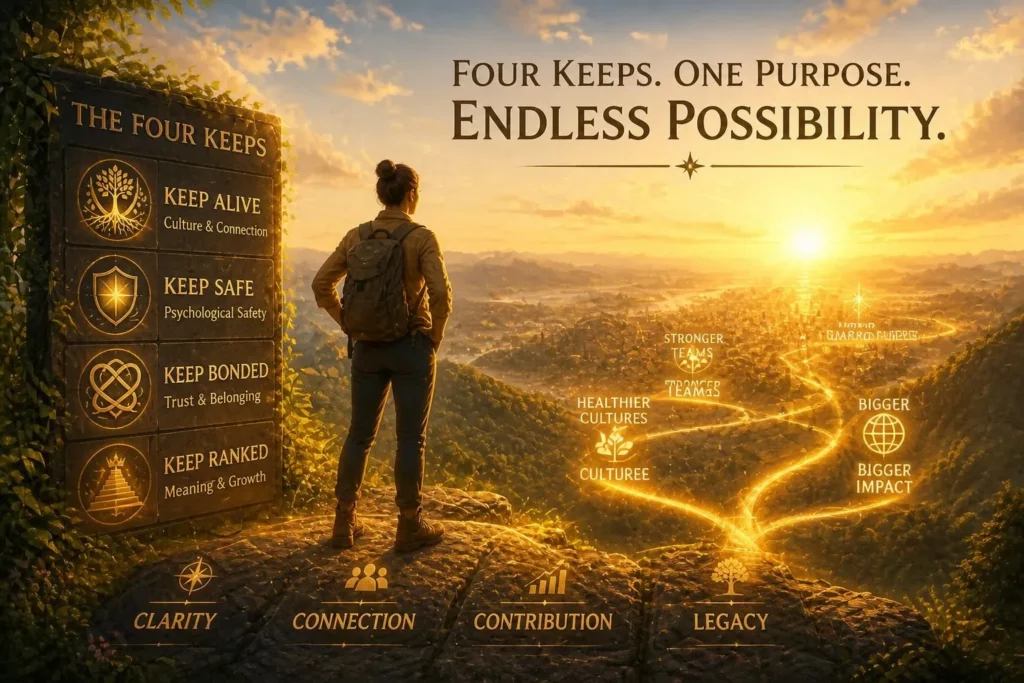
Post Script
This article was originally developed by Jeremiah Josey and represents an integration of insights from evolutionary psychology, attachment theory, motivation science, and organisational behaviour. The framework is meant as a tool for understanding, not as a prescription for how human beings “should” be.
Further Reading
- Evolutionary Psychology: The New Science of the Mind — David Buss. A strong foundation for understanding why human behaviour often follows deep survival, mating, and status logics.
- The Need to Belong — Roy Baumeister and Mark Leary’s classic belongingness work. Essential for understanding the social drive behind connection, acceptance, and exclusion.
- Belonging: The Science of Creating Connection and Bridging Divides — Geoffrey Cohen. A practical, modern look at how belonging shapes performance, trust, and identity.
- Self-Determination Theory — Edward Deci and Richard Ryan. Useful for reading the Four Keeps alongside autonomy, relatedness, and competence.
- Social Safety Theory — George Slavich. A great companion piece for understanding why safety, inclusion, and social threat matter so much.
- Affective Neuroscience — Jaak Panksepp. Helps explain the emotional systems beneath motivation, attachment, and survival behaviour.
- Tribe: On Homecoming and Belonging — Sebastian Junger. A more accessible, human-centered take on belonging, group life, and why people thrive together.
- The Advantage — Patrick Lencioni. Especially relevant for the “real teams and organizations” part of the article; focused on healthy organizational culture and cohesion.
- Leaders Eat Last — Simon Sinek. Good for thinking about trust, protection, and why people do their best work when they feel safe.
- The Power of Ritual — Casper ter Kuile. Useful if you want a more reflective angle on belonging, shared habits, and meaning-making.
About the Author
Jeremiah Josey is Chairman of MECi Group, specialising in transformative energy infrastructure and advanced nuclear solutions. With a focus on thorium-based technologies, he delivers large-scale, high-value projects across the Middle East, Asia, and Australia—structuring, financing, and executing complex, multi-billion-dollar ventures that redefine the energy landscape.
© 2026 Jeremiah Josey. All rights reserved. No part of this work may be reproduced, distributed, or adapted without prior written permission.
Leave a Reply
You must be logged in to post a comment.